Free standard shipping for orders over $340.
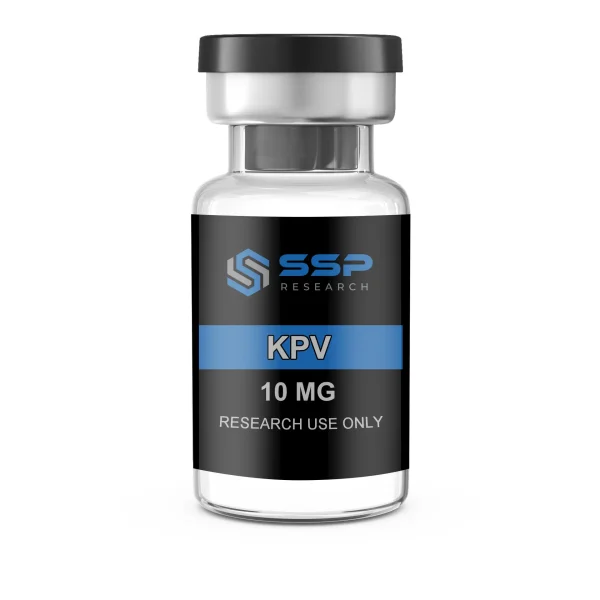
KPV 10mg
$62.00
KPV 10mg is a high-purity tripeptide (Lys-Pro-Val) derived from the C-terminal fragment of alpha-melanocyte-stimulating hormone ($\alpha$-MSH). This 10mg concentration is specifically synthesized for laboratory research into inflammatory signaling pathways, antimicrobial activity, and gut-brain axis modulation.
| Property | Specification |
|---|---|
| Compound Name | KPV (α-MSH 11–13) |
| Sequence | Lys-Pro-Val (lysine-proline-valine) |
| Molecular Formula | C₁₆H₃₀N₄O₄ |
| Molecular Weight | 342.43 g/mol |
| Parent Molecule | Alpha-melanocyte-stimulating hormone (α-MSH), C-terminal fragment |
| Uptake Route | PepT1 di/tripeptide transporter |
| Mechanism | Receptor-independent NF-κB / IKK inhibition |
| Purity Rating | >99% (HPLC & MS verified) |
| Format | White lyophilized powder |
| Solubility | Water-soluble; bacteriostatic water for reconstitution |
| Storage | -20°C, desiccated, away from light and moisture |
KPV 10mg for Sale Online | 99% Pure Anti-Inflammatory α-MSH Tripeptide (Lys-Pro-Val)
Alpha-MSH is a powerful anti-inflammatory hormone — but it also tans your skin and suppresses appetite, which makes it a blunt instrument for studying inflammation on its own. So researchers asked a neat question: could you keep the anti-inflammatory punch and drop everything else? The answer turned out to be its last three amino acids. KPV (Lys-Pro-Val) is that fragment — the “business end” of α-MSH, retaining much of its inflammation-calming activity while shedding the pigmentation and appetite effects entirely.
KPV 10mg is the high-purity research form of that tripeptide, and it does something genuinely clever: in some models it cuts NF-κB nuclear translocation — the master switch of inflammation — by up to 80% (Peptpedia, 2026). From gut inflammation to skin to antimicrobial work, it’s become one of the most-studied small peptides in immune research. Let me walk you through why it’s special, then where to buy it.
Scope note: research-grade material for in-vitro and laboratory use by qualified professionals only. Not FDA-approved, not for human or veterinary use, and nothing here is a dosing protocol. All findings described are preclinical.
What KPV Is: The Business End of α-MSH
KPV is a tripeptide — lysine, proline, valine — corresponding to residues 11–13 at the C-terminus of alpha-melanocyte-stimulating hormone. Its autonomous anti-inflammatory activity was first identified by Hiltz and Lipton back in 1989 (GhostLabz research notes, 2026), and it’s been a melanocortin-research staple ever since.
The defining feature is what it doesn’t do. Full α-MSH activates melanocortin receptors (MC1R and others), which is why it drives tanning. KPV, at physiologically relevant concentrations, doesn’t meaningfully bind those receptors — its anti-inflammatory action is largely receptor-independent, working directly inside the cell (Peptpedia, 2026). Same calming signal, none of the pigment. That clean separation is the whole reason the isolated tripeptide became a research focus.
The PepT1 Trick: A Peptide That Targets Inflamed Tissue
Here’s the part of the KPV story that makes researchers sit up. A landmark study in Gastroenterology showed that KPV is actively ferried into intestinal epithelial and immune cells by PepT1, a di/tripeptide transporter. And PepT1 has a fascinating quirk: it’s upregulated in inflamed tissue during inflammatory bowel disease.
Follow the logic and it’s elegant. Inflamed gut tissue expresses more of the transporter, so it pulls in more KPV — giving the peptide a degree of natural self-targeting to exactly the tissue that’s diseased. Researchers confirmed the dependency with PepT1-knockout mice, in which KPV lost its anti-inflammatory and anti-tumorigenic effects entirely. No transporter, no effect — clean evidence for the route.
How KPV Calms Inflammation
Once inside the cell, KPV goes after the central inflammatory machinery. It inhibits NF-κB and the IκB kinase (IKK) pathway — the signaling axis that switches on inflammatory gene expression — and suppresses production of pro-inflammatory cytokines including TNF-α, IL-1β, IL-6, and IL-8. Two things make this notable for research: it works at nanomolar concentrations, and it works orally in models — rare traits for a peptide, and part of why gut-targeted studies favor it.
Luger and Brzoska (2007) mapped the broader picture: KPV touches multiple inflammatory pathways — NF-κB activation, adhesion-molecule expression, chemokine signaling — acting on both immune cells (macrophages, lymphocytes, dendritic cells) and resident tissue cells (epithelial cells, keratinocytes)
Where KPV Fits in Research
| Research Focus | What’s Being Investigated |
|---|---|
| NF-κB Inhibition | Suppression of pro-inflammatory cytokine expression via NF-κB/IKK |
| Intestinal Homeostasis | Colonic inflammation and mucosal-barrier integrity in colitis models |
| Antimicrobial Properties | Direct activity against Candida albicans and Staphylococcus aureus |
| Dermatological Inflammation | Keratinocyte NF-κB signaling in dermatitis and vasculitis models |
| PepT1 Transport Biology | Peptide uptake dynamics in inflamed vs healthy tissue |
| Gut-Brain Axis Modulation | Immune signaling along the intestinal-neural interface |
The Evidence, By the Numbers
| Finding | Result | Model / Context | Source |
|---|---|---|---|
| NF-κB translocation | Reduced up to 80% | Cellular inflammation models | Peptpedia, 2026 |
| Colitis severity | Reduced 50%+ (oral) | DSS/TNBS mouse models | The Peptide Catalog, 2026 |
| PepT1 dependency | Effects lost in knockouts | PepT1-knockout mice | Peptidepedia, 2026 |
| Active concentration | Nanomolar | Cellular assays | The Peptide Catalog, 2026 |
| First described | 1989 (Hiltz & Lipton) | Autonomous anti-inflammatory activity | GhostLabz, 2026 |
| Molecular weight | 342.43 g/mol | Tripeptide | ChemVerify, 2026 |
One honest note: the gut-inflammation evidence is the strongest, but it’s preclinical — no human clinical trials have confirmed these effects. And the mechanism isn’t fully settled: while receptor-independent NF-κB inhibition is the dominant account, some reports describe residual melanocortin-receptor interaction. Strong, coherent research — with open questions, as good science should have.
Expanded Technical Specifications
| Property | Specification |
|---|---|
| Compound Name | KPV (α-MSH 11–13) |
| Sequence | Lys-Pro-Val (lysine-proline-valine) |
| Molecular Formula | C₁₆H₃₀N₄O₄ |
| Molecular Weight | 342.43 g/mol |
| Parent Molecule | Alpha-melanocyte-stimulating hormone (α-MSH), C-terminal fragment |
| Uptake Route | PepT1 di/tripeptide transporter |
| Mechanism | Receptor-independent NF-κB / IKK inhibition |
| Purity Rating | >99% (HPLC & MS verified) |
| Format | White lyophilized powder |
| Solubility | Water-soluble; bacteriostatic water for reconstitution |
| Storage | -20°C, desiccated, away from light and moisture |
The GLP1 Peptides Quality Standard
| Standard | What You Get |
|---|---|
| Verified 99%+ Purity | Every batch confirmed by HPLC and Mass Spectrometry |
| Advanced Lyophilization | Freeze-drying that protects the Lys-Pro-Val sequence |
| Analytical Transparency | A batch-specific Certificate of Analysis (COA) with every order |
| Synthesis Precision | Exact molecular sequencing for consistent, reproducible results |
For a three-residue peptide, sequence fidelity is everything — the COA confirms you have genuine KPV, not a mislabeled or impure tripeptide.
Reconstituting KPV in the Lab
KPV is small and water-soluble, which makes handling straightforward — but it’s sensitive to heat, light, and moisture, so a little care pays off. Let the sealed vial reach room temperature, then add bacteriostatic or sterile water gently down the inner glass wall rather than onto the powder. Swirl until dissolved; don’t shake. Aliquot into single-use portions to spare the rest from freeze-thaw stress.
Store the lyophilized powder at -20°C, desiccated and shielded from light. Once reconstituted, keep it at 2–8°C, protect it from light, and avoid repeated freeze-thaw cycles. Discard any solution that turns cloudy or discolored.
KPV vs α-MSH vs Other Anti-Inflammatory Peptides
| Compound | What It Is | Research Profile |
|---|---|---|
| KPV (this product) | α-MSH C-terminal tripeptide | Anti-inflammatory, no pigmentation; NF-κB inhibition; PepT1-transported |
| Alpha-MSH (full) | 13-residue melanocortin hormone | Anti-inflammatory plus tanning and appetite effects |
| BPC-157 | Gastric pentadecapeptide | Gut healing via angiogenesis and growth factors (different mechanism) |
| KdPT | Lys-D-Pro-Thr derivative | Related tripeptide; comparable anti-inflammatory potency |
The distinction that matters: KPV isolates α-MSH’s anti-inflammatory signal from its pigmentary one, and it calms inflammation from inside the cell via NF-κB — where BPC-157, another popular gut-research peptide, works through tissue regeneration and blood-vessel growth instead. Different doors to a related room, which is why they sometimes appear together in gut research.
KPV 10mg for Sale — Shipping Worldwide
Our research-grade KPV 10mg ships as HPLC/MS-verified, COA-backed lyophilized vials, sealed and bench-ready. We fulfill orders for laboratories and independent researchers across the highest-demand markets:
- 🇺🇸 USA — fast domestic dispatch
- 🇨🇦 Canada — reliable cross-border delivery
- 🇩🇪 Germany (Deutschland) — trusted EU logistics
- 🇫🇷 France — secure European shipping
When you buy KPV 10mg from GLP1 Peptides, you’re getting a verified Lys-Pro-Val tripeptide backed by documentation — because for a peptide whose activity rides on getting three amino acids exactly right, identity confirmation is the product.
FAQs about KPV 10mg
1. What is KPV 10mg? A 10mg vial of KPV (Lys-Pro-Val), the anti-inflammatory C-terminal tripeptide of α-MSH, supplied as a lyophilized powder for inflammation, gut, and immune research.
2. Why doesn’t KPV cause tanning like α-MSH? Because it doesn’t meaningfully activate melanocortin receptors (MC1R). Its anti-inflammatory action is largely receptor-independent, so it keeps the calming effect without the pigmentation
3. How does KPV reduce inflammation? It enters cells and inhibits the NF-κB and IκB kinase pathways, cutting production of pro-inflammatory cytokines like TNF-α, IL-1β, IL-6, and IL-8 — reducing NF-κB translocation by up to 80% in some models
4. What is PepT1 and why does it matter for KPV? PepT1 is the transporter that carries KPV into intestinal cells. It’s upregulated in inflamed gut tissue, so KPV is preferentially pulled into diseased tissue — a form of natural self-targeting confirmed in knockout studies
5. Is the gut research on KPV strong? It’s the strongest part of the literature — oral KPV reduced colitis severity by 50%+ in mouse models — but it remains preclinical, with no confirmed human clinical trials yet.
6. Does KPV have antimicrobial activity? Research describes direct activity against pathogens including Candida albicans and Staphylococcus aureus, consistent with its classification as a host-defense peptide.
7. What’s the difference between KPV and full α-MSH? KPV is just the last three residues (11–13) of α-MSH. It keeps the anti-inflammatory activity but drops the melanocortin-receptor effects — tanning and appetite suppression.
8. Is KPV FDA approved? No. It’s research-only, not approved for human use, and its effects have not been confirmed in human trials.
9. Does KPV work orally in research models? Yes — one of its notable features is oral bioactivity in animal models, largely thanks to PepT1-mediated uptake in the gut. (That’s a research observation, not a use instruction.)
10. How should KPV 10mg be stored? Lyophilized powder at -20°C, desiccated and away from light; reconstituted solution at 2–8°C, protected from light, with freeze-thaw cycles avoided.
11. How do you reconstitute KPV? Room-temperature vial, bacteriostatic or sterile water added slowly down the glass wall, gentle swirl, then aliquot. The handling section above covers it.
12. Where can I buy KPV 10mg internationally? GLP1 Peptides ships research-grade, COA-verified KPV 10mg to the USA, Canada, Germany, and France in sealed lyophilized vials. See the shipping section above.
Reviews
There are no reviews yet.