Free standard shipping for orders over $340.
GHK-CU Copper 100mg
$53.00
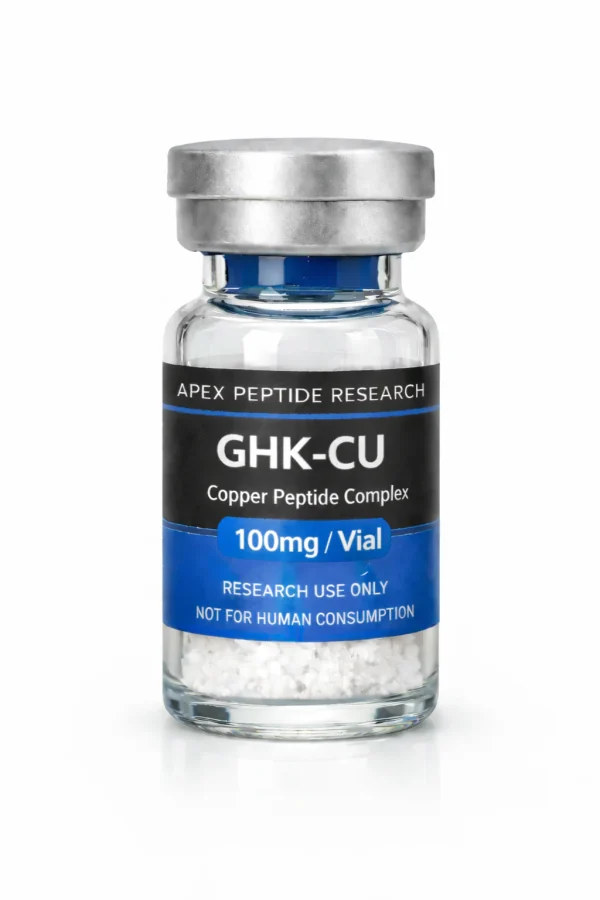
GHK-CU Copper 100mg is an industrial-scale copper complex tripeptide synthesized for advanced institutional and academic research. Each vial contains 100mg of the high-stability GHK-Cu compound, verified at 99% or higher purity. This research-grade peptide is lyophilized to ensure maximum structural integrity and consistent results in large-volume studies focused on cellular regeneration and biochemical signaling.
| Property | Specification |
|---|---|
| Compound | GHK-Cu (copper tripeptide-1) |
| Sequence | Glycyl-L-histidyl-L-lysine + copper(II) |
| CAS Number | 49557-75-7 |
| Molecular formula | C₁₄H₂₂CuN₆O₄ |
| Molecular weight | ~340 g/mol (peptide) / ~404 g/mol (copper complex) |
| Vial concentration | 100mg single compound |
| Purity | >99% (HPLC & MS verified) |
| Appearance | Deep blue lyophilized powder |
| Storage | -20°C for long-term stability |
GHK-Cu Copper 100mg for Sale | 99% Pure High-Yield Copper Tripeptide
Here’s a fact that reframes how you think about GHK-Cu: this tiny three-amino-acid copper peptide influences the expression of roughly 4,000 human genes, about 31% of the entire genome. It doesn’t just do one thing. It behaves less like a single-target compound and more like a switchboard for tissue repair, collagen synthesis, antioxidant defense, and cellular signaling all at once.
GHK-Cu Copper 100mg is the high-yield, research-grade form of that switchboard — a deep-blue lyophilized powder verified at 99%+ purity, synthesized for the large-volume studies where a small vial won’t stretch far enough. Whether your lab works on dermal remodeling, musculoskeletal repair, or gene-expression models, the industrial format keeps you supplied. Let’s get into what makes this molecule tick, then where to buy it.
Scope note: supplied for in-vitro and laboratory research by qualified professionals. This research material is not a drug, cosmetic, or supplement, has not been approved for human use, and nothing below is a use protocol or medical claim.
The Copper Connection
Most peptides are just chains of amino acids. GHK-Cu is something more interesting: a peptide (glycyl-L-histidyl-L-lysine) locked in coordination with a copper(II) ion. That copper isn’t decoration — it’s functional. Copper serves as an essential cofactor for lysyl oxidase and lysyl hydroxylase, the enzymes that cross-link collagen so newly built tissue holds together instead of staying weak (Pulse & Remedy overview, 2025).
The compound was first identified in human blood plasma in 1973, and researchers noticed something telling: its concentration drops sharply with age. That decline is part of why exogenous GHK-Cu became such a focus in regenerative research. And that unmistakable deep-blue color of the powder? Pure copper chemistry — completely normal, and a quick visual signature that you’ve got the real complex.
A Master Regulator of Gene Expression
This is where GHK-Cu earns the “master regulator” label. Rather than binding a single receptor and flipping one switch, it appears to act as a broad upregulator of the extracellular matrix, telling fibroblasts to ramp up production of collagen, elastin, and glycosaminoglycans, while also stimulating decorin — the proteoglycan that organizes collagen fibers (PMC skin-regeneration review, 2026).
It’s a two-way regulator, too, not just an accelerator. GHK-Cu modulates matrix metalloproteinases and their inhibitors (TIMP-1, TIMP-2), which is exactly the balancing act controlled tissue remodeling requires — build and break down in the right proportions. Add its antioxidant and anti-inflammatory activity, plus upregulation of VEGF and bFGF in damaged fibroblasts (PRIME Journal), and you can see why a single small molecule generates such a wide research literature.
Where GHK-Cu 100mg Fits in Research
The high-dose format opens up the multi-arm, high-volume designs this molecule invites:
| Research Focus | What’s Being Investigated |
|---|---|
| Collagen & Dermal Remodeling | Collagen, elastin, and decorin synthesis; skin-structure research |
| ECM Modulation | MMP/TIMP balance and matrix remodeling dynamics |
| Gene-Expression Models | Broad transcriptional effects across regenerative pathways |
| Antioxidant & Anti-inflammatory Signaling | Free-radical quenching and inflammatory-mediator modulation |
| Musculoskeletal Repair | Copper-peptide signaling in tendon and ligament cell models |
| Emerging Neuroprotection | Amyloid and cognitive-pathway research in early-stage models |
Why the 100mg Industrial Format?
Simple math: high-dose dermal and ECM studies burn through material fast, and multi-arm designs multiply that demand. The 100mg vial lets a lab run collagen, wound, and gene-expression conditions from one verified lot — which keeps batch-to-batch variance out of a comparative dataset. For a compound whose whole appeal is broad, multi-pathway effects, you often want more experimental arms, not fewer, and the industrial format makes that practical. Running a single-condition pilot instead? The 50mg vial is the leaner fit.
Specifications and Quality Control
| Property | Specification |
|---|---|
| Compound | GHK-Cu (copper tripeptide-1) |
| Sequence | Glycyl-L-histidyl-L-lysine + copper(II) |
| CAS Number | 49557-75-7 |
| Molecular formula | C₁₄H₂₂CuN₆O₄ |
| Molecular weight | ~340 g/mol (peptide) / ~404 g/mol (copper complex) |
| Vial concentration | 100mg single compound |
| Purity | >99% (HPLC & MS verified) |
| Appearance | Deep blue lyophilized powder |
| Storage | -20°C for long-term stability |
Every batch is confirmed to 99%+ purity by HPLC and Mass Spectrometry, freeze-dried to protect the copper-peptide complex, and shipped with a batch-specific COA verifying identity and copper coordination. With a metal-complex peptide, that identity check matters — you’re verifying not just the sequence but that the copper is properly bound.
Handling the 100mg in the Lab
Copper peptides are stable, but light and repeated freeze-thaw are still their enemies. Let the sealed vial reach room temperature before opening, then add bacteriostatic or sterile water gently down the inner glass wall rather than onto the powder. Swirl until the solution turns a clear blue — don’t shake. Then divide it into single-use aliquots straight away, which matters more with a 100mg vial you’ll return to repeatedly.
Keep the powder frozen at -20°C, sealed and out of direct light to protect the copper complex. Reconstituted, store it at 2–8°C, shielded from light, and use it within a few weeks. The solution should stay a clean blue; anything cloudy or off-tone gets retired.
GHK-Cu vs Other Regenerative Research Peptides
| Compound | Primary Mechanism | Research Lane |
|---|---|---|
| GHK-Cu | Gene modulation + ECM remodeling | Collagen, skin, matrix, antioxidant (most human topical use) |
| BPC-157 | VEGF / nitric-oxide cytoprotection | Angiogenesis and tissue protection |
| TB-500 | Actin sequestration | Cell migration and cytoskeletal repair |
| Epithalon | Telomerase / pineal axis | Telomere and longevity research |
The distinction: GHK-Cu is the extracellular-matrix and gene-expression specialist of this group. Where BPC-157 and TB-500 drive repair through vasculature and cell movement, GHK-Cu rebuilds the collagen scaffold and reprograms the transcriptional environment around it (MDPI review). Different tool, different job — which is why researchers sometimes study them together.
GHK-Cu Copper 100mg for Sale — Shipping Worldwide
Our research-grade GHK-Cu Copper 100mg ships as HPLC/MS-verified, COA-backed deep-blue lyophilized vials, sealed and bench-ready. We fulfill orders for laboratories and independent researchers across the highest-demand markets:
- 🇺🇸 USA — fast domestic dispatch
- 🇨🇦 Canada — reliable cross-border delivery
- 🇩🇪 Germany (Deutschland) — trusted EU logistics
- 🇫🇷 France — secure European shipping
When you buy GHK-Cu in the 100mg industrial format, you’re buying enough consistent, verified material to run a genuinely ambitious study — one lot, one COA, across every experimental arm. For multi-pathway research, that consistency is the difference between clean comparisons and confounded ones.
FAQs about GHK-Cu Copper 100mg
1. What is GHK-Cu Copper 100mg? A high-yield 100mg vial of GHK-Cu (glycyl-L-histidyl-L-lysine copper), a naturally occurring copper tripeptide supplied as a deep-blue lyophilized powder for regenerative and gene-expression research.
2. Why is the powder blue? The blue comes from the bound copper(II) ion. It’s an expected, normal feature of the complex — and a handy visual confirmation you have genuine GHK-Cu, not an uncomplexed peptide.
3. What does GHK-Cu do? It acts as a broad regulator: modulating thousands of genes, stimulating collagen, elastin, and glycosaminoglycan synthesis, balancing MMPs and their inhibitors, and providing antioxidant and anti-inflammatory activity
4. Why does the copper matter? Copper is a required cofactor for the lysyl oxidase enzymes that cross-link collagen. Without adequate copper, newly built collagen stays weak — so the metal is central to GHK-Cu’s regenerative research profile.
5. What’s the difference between the 50mg and 100mg? Only the quantity. The 100mg suits high-dose, multi-arm, or high-volume studies where one consistent lot matters; the 50mg suits smaller single-condition work.
6. Is GHK-Cu FDA approved? It’s widely used topically in cosmetics, but this injectable-grade research material is not FDA-approved as a drug and is supplied for laboratory research only.
7. What’s the molecular weight of GHK-Cu? It’s reported as roughly 340 g/mol for the peptide or ~404 g/mol for the copper complex, depending on mass-spectrometry conditions. CAS 49557-75-7.
8. How should GHK-Cu 100mg be stored? Powder frozen at -20°C, sealed and out of the light; reconstituted solution at 2–8°C, protected from light, used within a few weeks. Avoid freeze-thaw cycles.
9. How do you reconstitute GHK-Cu? Warm the vial, add bacteriostatic or sterile water slowly down the glass wall, swirl gently to a clear blue, then aliquot. The handling section above walks through it.
10. Is the neuroprotection research on GHK-Cu solid? It’s genuinely interesting but early — preclinical models exploring amyloid reduction and cognition. Treat it as an emerging direction, not established fact.
11. What purity should GHK-Cu be? Aim for 99%+ confirmed by HPLC and Mass Spectrometry, with a lot-specific COA verifying identity and copper coordination. Ours ships with that.
12. Where can I buy GHK-Cu Copper 100mg internationally? GLP1 Peptides ships research-grade, COA-verified GHK-Cu Copper 100mg to the USA, Canada, Germany, and France in sealed deep-blue lyophilized vials. See the shipping section above.
Reviews
There are no reviews yet.