Free standard shipping for orders over $340.

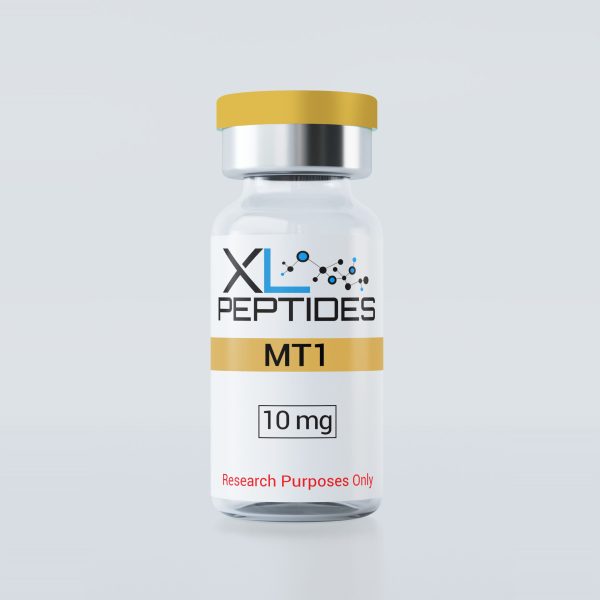
Melanotan 1 (MT-1)
$48.00
Melanotan 1 (MT-1) is a high-purity synthetic analog of the naturally occurring alpha-melanocyte-stimulating hormone ($\alpha$-MSH). This 13-amino acid peptide is specifically synthesized for advanced research into melanogenesis and photoprotection. Each vial is lyophilized to ensure maximum structural integrity and consistent results in specialized institutional studies.
| Property | Specification |
|---|---|
| Compound Name | Melanotan 1 (MT-1) / Afamelanotide / Nle⁴-D-Phe⁷-α-MSH |
| Sequence | Ac-Ser-Tyr-Ser-Nle-Glu-His-D-Phe-Arg-Trp-Gly-Lys-Pro-Val-NH₂ |
| Molecular Formula | C₇₈H₁₁₁N₂₁O₁₉ |
| Molecular Weight | ~1646.9 g/mol |
| Amino Acid Count | 13 (linear tridecapeptide) |
| Receptor Target | MC1R-selective agonist |
| Structural Notes | N-acetyl and C-amide termini extend half-life vs native α-MSH |
| Parent Molecule | Alpha-melanocyte-stimulating hormone (α-MSH) |
| Purity Rating | >99% (HPLC & MS verified) |
| Format | White lyophilized powder |
| Storage | -20°C, protected from UV light and moisture |
Melanotan 1 (MT-1) for Sale Online | 99% Pure MC1R-Selective α-MSH Analog (Afamelanotide)
Most research peptides never make it out of the lab. Melanotan 1 did. After more than 20 years of development that began at the University of Arizona under Victor Hruby and Mac Hadley, this α-MSH analog became afamelanotide — brand name Scenesse — the first melanocortin agonist ever to earn regulatory approval (Peptide Protocol Wiki, 2026). That pedigree is rare, and it’s exactly why MT-1 is such a well-characterized tool for melanogenesis and photoprotection research.
Here’s the nuance every serious buyer should understand up front: the approved drug and the research peptide are the same molecule in two very different contexts. This page is about the research-grade Melanotan 1 (MT-1) — a high-purity, MC1R-selective lyophilized peptide for laboratory study. Let me walk you through the science, clear up a common mix-up about its receptor selectivity, and show you where to buy it.
Scope note: research-grade material for in-vitro and laboratory use by qualified professionals only. This bulk lyophilized powder is not the approved pharmaceutical (Scenesse), is not approved for human, cosmetic, or veterinary use, and nothing here is a dosing protocol.
MT-1 and Afamelanotide: Same Molecule, Two Worlds
Let’s clear this up because it trips up almost everyone. Melanotan 1 and afamelanotide are chemically identical — both are Nle⁴-D-Phe⁷-α-MSH, a 13-amino-acid linear analog of alpha-melanocyte-stimulating hormone (Peptide Protocol Wiki, 2026). What differs is context, not chemistry:
- Afamelanotide (Scenesse) is the FDA-approved (2019) and EMA-approved (2014) pharmaceutical — a controlled-release 16 mg implant approved solely for erythropoietic protoporphyria (EPP), a rare disorder causing severe pain from light exposure. There is no approved cosmetic or tanning indication.
- Research-grade MT-1 is that same peptide supplied as a lyophilized powder for laboratory research — not the approved drug, and not for human use.
The upshot for researchers: MT-1 is unusual among research peptides in having genuine Phase 3 clinical data (the Scenesse trials) behind its pharmacology. That’s a real E-E-A-T advantage when you’re building a study — the science is validated, even though the research powder isn’t a medicine.
MC1R Selectivity: Why MT-1 Isn’t MT-2
This is the single most misstated fact about Melanotan 1, so let’s get it right. MT-1 is an MC1R-selective agonist — it primarily activates the melanocortin-1 receptor on melanocytes, with minimal activity at MC3R, MC4R, and MC5R. (If you’ve seen it described as “non-selective across all four melanocortin receptors,” that’s actually the profile of MT-2, the cyclic derivative — not MT-1.)
Why does this matter? Because that selectivity gives MT-1 a distinctly cleaner pharmacological profile. MT-2’s broad activity — especially at MC4R in the brain — is what produces the nausea, flushing, and other systemic effects associated with it. MT-1’s linear structure, closer to native α-MSH, largely avoids that off-target pharmacology, which is precisely why melanogenesis researchers favor it when they want to study pigmentation without confounding CNS effects.
The Eumelanin Advantage
Now the mechanism worth understanding. When MT-1 activates MC1R on melanocytes, it drives production of eumelanin — the dark brown-black pigment that absorbs UV radiation and scavenges free radicals. That’s the important distinction from pheomelanin, the reddish-yellow pigment that actually generates free radicals under UV. By shifting the melanin ratio toward eumelanin, MT-1 is studied for genuine photoprotection at the cellular level, not merely cosmetic darkening (Peptide Wiki, 2026).
There’s an elegant contrast at the heart of the research, too. Normal UV-induced tanning requires DNA damage to trigger melanin production — that’s the biological alarm going off. MT-1 stimulates the pigment machinery directly, bypassing that damage step. That said, models generally show some UV exposure is still needed to fully actualize the pigment, which keeps the UV-interaction question an active area of study.
Where MT-1 Fits in Research
| Research Focus | What’s Being Investigated |
|---|---|
| Melanogenesis Induction | Biochemical pathways triggering eumelanin production in melanocytes |
| Photoprotective Mechanisms | Cellular-level defense against UV radiation |
| MC1R Signaling | Receptor activation and its role in pigmentation and DNA repair |
| Comparative Pharmacology | MT-1 vs native α-MSH and MT-2 receptor profiles |
| EPP & Photosensitivity Models | The biology validated by the afamelanotide clinical program |
The Evidence, By the Numbers
| Detail | Value | Context | Source |
|---|---|---|---|
| Regulatory milestone | FDA 2019 / EMA 2014 | Scenesse, first approved melanocortin agonist | Superpower, 2026 |
| Approved indication | EPP only (16 mg implant) | No cosmetic/tanning approval | Superpower, 2026 |
| Receptor selectivity | MC1R-selective | Minimal MC3R/MC4R/MC5R activity | Peptide Wiki, 2026 |
| Injection half-life | ~30 minutes | Melanogenesis effects persist days–weeks | Peptide Wiki, 2026 |
| Origin | 1980s–90s, Univ. of Arizona | Hruby & Hadley | Peptide Protocol Wiki, 2026 |
| Key clinical reference | Langendonk et al., NEJM 2015 | Afamelanotide for EPP (PMID 26132941) | CalcMyPeptide, 2026 |
A safety note grounded in that clinical record: the Scenesse data show no serious organ toxicities, and no increased melanoma incidence — but because any compound that broadly stimulates MC1R raises a theoretical question about melanocyte activity, dermatological monitoring of pigmented lesions is a standard precaution in the clinical setting. Useful context for research design.
Expanded Technical Specifications
| Property | Specification |
|---|---|
| Compound Name | Melanotan 1 (MT-1) / Afamelanotide / Nle⁴-D-Phe⁷-α-MSH |
| Sequence | Ac-Ser-Tyr-Ser-Nle-Glu-His-D-Phe-Arg-Trp-Gly-Lys-Pro-Val-NH₂ |
| Molecular Formula | C₇₈H₁₁₁N₂₁O₁₉ |
| Molecular Weight | ~1646.9 g/mol |
| Amino Acid Count | 13 (linear tridecapeptide) |
| Receptor Target | MC1R-selective agonist |
| Structural Notes | N-acetyl and C-amide termini extend half-life vs native α-MSH |
| Parent Molecule | Alpha-melanocyte-stimulating hormone (α-MSH) |
| Purity Rating | >99% (HPLC & MS verified) |
| Format | White lyophilized powder |
| Storage | -20°C, protected from UV light and moisture |
The GLP1 Peptides Quality Standard
| Standard | What You Get |
|---|---|
| Verified 99%+ Purity | Every batch confirmed by HPLC and Mass Spectrometry |
| Advanced Lyophilization | Freeze-drying that protects the 13-residue sequence |
| Analytical Transparency | A batch-specific Certificate of Analysis (COA) with every order |
| Technical Precision | Exact sequencing, including verified D-Phe⁷ integrity |
That D-Phe⁷ detail matters more than it sounds: the D-amino-acid substitution is central to MT-1’s stability and activity, so the COA confirming it is confirming you have genuine MT-1, not a degraded or mis-synthesized analog.
Reconstituting MT-1 in the Lab
Melanotan 1 is light-sensitive — that’s worth remembering, given it’s a pigmentation peptide. Bring the sealed vial to room temperature, then add bacteriostatic or sterile water gently down the inner glass wall rather than onto the powder. Swirl until dissolved; never shake. Aliquot into single-use portions to protect the rest from freeze-thaw stress.
Store the lyophilized powder at -20°C, sealed and shielded from UV light and moisture. Once reconstituted, keep it cold and dark at 2–8°C, and avoid repeated freeze-thaw cycles. Any cloudiness or discoloration and the vial is retired.
MT-1 vs MT-2 vs α-MSH
| Compound | Structure | Receptor Profile | Note |
|---|---|---|---|
| MT-1 (this product) | Linear 13-aa (Nle⁴-D-Phe⁷) | MC1R-selective | Cleaner profile; approved as Scenesse for EPP |
| MT-2 (Melanotan II) | Cyclic 7-aa | MC1R + MC3R + MC4R + MC5R | Broader activity; MC4R effects (nausea, etc.) |
| Native α-MSH | Linear 13-aa | Melanocortin agonist | Very short-acting; the parent hormone |
| Afamelanotide implant | Same as MT-1 | MC1R-selective | The FDA/EMA-approved pharmaceutical form |
The clean takeaway: MT-1 and MT-2 both stimulate melanogenesis, but MT-1’s MC1R selectivity is what separates it — pigmentation research without the broad melanocortin pharmacology that complicates MT-2 studies.
Melanotan 1 (MT-1) for Sale — Shipping Worldwide
Our research-grade Melanotan 1 (MT-1) ships as HPLC/MS-verified, COA-backed lyophilized vials, sealed and bench-ready with cold-pack protection. We fulfill orders for laboratories and independent researchers across the highest-demand markets:
- 🇺🇸 USA — fast domestic dispatch
- 🇨🇦 Canada — reliable cross-border delivery
- 🇩🇪 Germany (Deutschland) — trusted EU logistics
- 🇫🇷 France — secure European shipping
When you buy Melanotan 1 (MT-1) from GLP1 Peptides, you’re getting a verified MC1R-selective analog with confirmed D-Phe⁷ integrity — the sequence fidelity that separates a reliable research tool from a mislabeled powder.
FAQs about Melanotan 1 (MT-1)
1. What is Melanotan 1 (MT-1)? A 13-amino-acid linear synthetic analog of α-MSH (Nle⁴-D-Phe⁷-α-MSH), supplied as a lyophilized powder for melanogenesis and photoprotection research. It’s chemically identical to afamelanotide.
2. Is MT-1 the same as afamelanotide (Scenesse)? Yes, same molecule. Afamelanotide (Scenesse) is the FDA/EMA-approved pharmaceutical implant for EPP; research-grade MT-1 is the same peptide sold as a powder for laboratory research, not as the approved drug.
3. Is MT-1 selective or non-selective? MC1R-selective. It primarily activates MC1R with minimal MC3R/MC4R/MC5R activity. The “non-selective across all four” description belongs to MT-2, not MT-1.
4. What’s the difference between MT-1 and MT-2? MT-1 is a linear, MC1R-selective peptide with a cleaner profile. MT-2 is a shorter cyclic peptide that also hits MC3R and MC4R, producing broader effects like nausea and flushing.
5. How does MT-1 produce pigment? It activates MC1R on melanocytes, driving eumelanin (dark, photoprotective pigment) production — bypassing the DNA-damage step that normal UV tanning requires, though some UV is generally still needed to fully realize the pigment.
6. What is eumelanin vs pheomelanin? Eumelanin is the brown-black pigment that absorbs UV and scavenges free radicals; pheomelanin is the reddish pigment that generates them. MT-1 research centers on shifting the balance toward protective eumelanin.
7. Is MT-1 FDA approved? The pharmaceutical form (Scenesse) is FDA-approved for EPP only. This research powder is not the approved drug and is not for human, cosmetic, or veterinary use.
8. What is MT-1’s half-life? About 30 minutes after injection, but melanogenesis effects persist for days to weeks because eumelanin accumulation is an ongoing biological process
9. Why is MT-1 considered a “cleaner” research tool than MT-2? Its MC1R selectivity means it studies pigmentation without the MC4R-mediated CNS and cardiovascular effects that complicate MT-2 experiments.
10. How should MT-1 be stored? Lyophilized powder at -20°C, protected from UV light and moisture; reconstituted solution at 2–8°C, kept dark, with freeze-thaw cycles avoided.
11. How do you reconstitute MT-1? Room-temperature vial, bacteriostatic or sterile water added slowly down the glass wall, gentle swirl, then aliquot. The handling section above covers it.
12. Where can I buy Melanotan 1 (MT-1) internationally? GLP1 Peptides ships research-grade, COA-verified MT-1 to the USA, Canada, Germany, and France in sealed lyophilized vials with cold-pack protection. See the shipping section above.
Reviews
There are no reviews yet.