Free standard shipping for orders over $340.
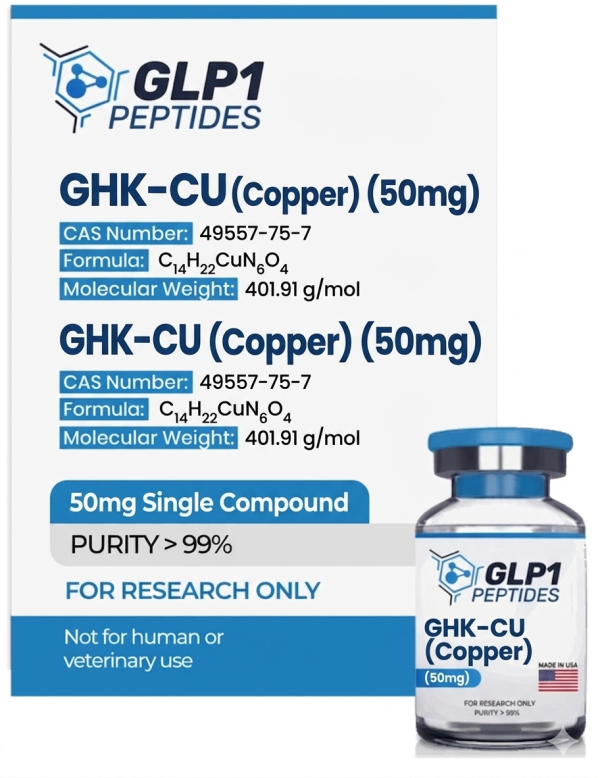
GHK-CU Copper 50mg
$64.00
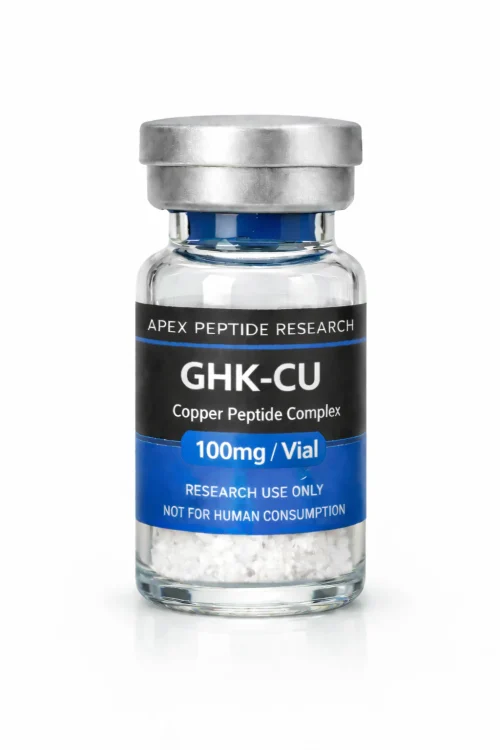
GHK-CU Copper 50mg is a premium, synthetically produced copper complex designed for rigorous institutional and academic research. Each vial contains 50mg of the high-stability GHK-Cu compound, verified at 99% or higher purity. This research-grade peptide is lyophilized to ensure long-term stability and consistent results in laboratory settings.
| Property | Specification |
|---|---|
| Compound | GHK-Cu (copper tripeptide-1) |
| Sequence | Glycyl-L-histidyl-L-lysine + copper(II) |
| CAS Number | 49557-75-7 |
| Molecular formula | C₁₄H₂₂CuN₆O₄ |
| Molecular weight | ~340 g/mol (peptide) / ~404 g/mol (copper complex) |
| Concentration | 50mg single compound |
| Purity | >99% (HPLC & MS verified) |
| Appearance | Deep blue lyophilized powder |
| Storage | -20°C for long-term stability |
GHK-Cu Copper 50mg for Sale | 99% Pure US-Made Copper Peptide for Repair Research
When tissue gets injured, your body does something clever: it releases GHK-Cu right at the wound site. This little copper tripeptide sits quietly bound in the extracellular matrix, and when damage occurs, it’s liberated to help orchestrate the repair — summoning immune and endothelial cells, kick-starting collagen, and calming inflammation (PMC skin-regeneration review, 2026). In animal models, that repair signal translates into wound closure roughly 40–50% faster than controls (Paragon Sports Medicine).
GHK-Cu Copper 50mg is the standard research-grade format of that repair peptide — a premium, US-handled, 99%+ pure copper complex sized for focused laboratory work. It’s the vial most labs reach for when they want a clean, reliable quantity for a defined study rather than an industrial stockpile. Here’s how the molecule works, what the evidence says, and where to buy it.
Scope note: supplied for in-vitro and laboratory research by qualified professionals. Not a drug, cosmetic, or supplement; not approved for human use; nothing below is a use protocol or medical claim.
Where GHK-Cu Fits in Research
Let’s start with the practical view — the questions labs actually bring to this compound:
| Research Focus | What’s Being Investigated |
|---|---|
| Tissue Repair & Wound Models | Fibroblast recruitment, granulation, and closure dynamics |
| Collagen & Skin Remodeling | Collagen, elastin, and proteoglycan synthesis |
| Metabolic & Regenerative Signaling | Copper-associated cellular communication pathways |
| Antioxidant Defense | Free-radical quenching and oxidative-stress reduction |
| Matrix Biology | Extracellular-matrix organization and remodeling |
Notice the breadth. That’s the recurring theme with GHK-Cu — it rarely does just one thing, which is exactly why it’s stayed in the research literature for half a century.
GHK-Cu at the Site of Injury
The mechanism worth understanding is the “carrier and signal” behavior. GHK-Cu is both a signaling molecule and a copper-transport peptide — it ferries copper, an essential trace element, to where enzymes need it (PRIME Journal). And copper isn’t a passenger here. It’s the required cofactor for lysyl oxidase, the enzyme that cross-links collagen into strong, organized tissue (Pulse & Remedy, 2025).
Once active, GHK-Cu tells fibroblasts to build — collagen, elastin, glycosaminoglycans, and decorin — while simultaneously balancing the matrix metalloproteinases that break tissue down. Build and remodel, in proportion. It’s this coordinated push-pull, not brute-force stimulation, that makes the peptide such a useful research model for controlled tissue repair.
The Evidence, By the Numbers
| Finding | Result | Model / Context | Source |
|---|---|---|---|
| Wound closure | 40–50% faster vs control | Animal wound models | Paragon Sports Medicine |
| Collagen synthesis | Up to 70% increase | Fibroblast cultures | Pulse & Remedy, 2025 |
| Subdermal density | +28% mean (3 months) | 2026 clinical ultrasound study | Pure Tested Peptides, 2026 |
| Gene modulation | ~4,000 genes (31%) | Gene-array analysis, 2018 | Regen Peptides, 2026 |
| Origin | Human plasma, 1973 | Declines with age | MDPI review |
Straight talk on the evidence: GHK-Cu has genuine depth, but a lot of it comes from topical and cosmetic research plus animal wound models. That’s a real, decades-long track record — just not identical to validated injectable-research outcomes, so weight each finding by its context.
The Copper, Briefly
That deep-blue color isn’t cosmetic — it’s the copper(II) ion bound into the peptide, and it’s how you eyeball a genuine complex at a glance. The metal is what gives GHK-Cu its edge over a plain tripeptide: it delivers a functional cofactor, not just a peptide sequence. CAS 49557-75-7, formula C₁₄H₂₂CuN₆O₄.
Where This Sits Among Regenerative Peptides
| Compound | Primary Mechanism | Research Lane |
|---|---|---|
| GHK-Cu | Copper delivery + ECM/collagen synthesis | Wound, skin, and matrix repair |
| BPC-157 | VEGF / nitric-oxide cytoprotection | Angiogenesis and tissue protection |
| TB-500 | Actin sequestration | Cell migration and cytoskeletal repair |
The clean way to think about it: BPC-157 and TB-500 move and protect cells; GHK-Cu rebuilds the collagen scaffold they’re working within — and supplies the copper that scaffold needs to set properly. Complementary jobs, which is why the three sometimes appear together in blend research.
Specifications and Quality Control
| Property | Specification |
|---|---|
| Compound | GHK-Cu (copper tripeptide-1) |
| Sequence | Glycyl-L-histidyl-L-lysine + copper(II) |
| CAS Number | 49557-75-7 |
| Molecular formula | C₁₄H₂₂CuN₆O₄ |
| Molecular weight | ~340 g/mol (peptide) / ~404 g/mol (copper complex) |
| Concentration | 50mg single compound |
| Purity | >99% (HPLC & MS verified) |
| Appearance | Deep blue lyophilized powder |
| Storage | -20°C for long-term stability |
Each lot is verified to 99%+ purity by HPLC and Mass Spectrometry, freeze-dried to preserve the fragile copper-peptide structure, handled domestically in the United States for a tight chain of quality, and shipped with a Certificate of Analysis (COA). For a metal-complex peptide, the COA confirms both sequence identity and proper copper coordination — you want to know the copper is actually bound.
Handling the 50mg in the Lab
| Step | What to Do |
|---|---|
| Warm | Let the sealed vial reach room temperature before opening |
| Add solvent | Add bacteriostatic or sterile water gently down the inner glass wall |
| Mix | Swirl to a clear blue; never shake |
| Aliquot | Divide into single-use portions to avoid freeze-thaw loss |
| Store | Powder at -20°C, dark; reconstituted at 2–8°C, out of the light, used within a few weeks |
Protect it from light to keep the copper complex intact, and retire any solution that turns cloudy or off-tone — a clean blue is what you want in the vial.
GHK-Cu Copper 50mg for Sale — US-Handled, Shipped Worldwide
Our research-grade GHK-Cu Copper 50mg is processed in the United States, verified by HPLC/MS, and shipped as COA-backed deep-blue lyophilized vials, sealed and bench-ready. We fulfill orders for laboratories and independent researchers across the highest-demand markets:
- 🇺🇸 USA — fast domestic dispatch
- 🇨🇦 Canada — reliable cross-border delivery
- 🇩🇪 Germany (Deutschland) — trusted EU logistics
- 🇫🇷 France — secure European shipping
Deciding to buy GHK-Cu at the 50mg standard? It’s the right call when you want a precise, verified quantity for a defined study — enough for real work, without paying for material you won’t use. Scale up to the 100mg format only when a high-volume, multi-arm design demands it.
FAQs about GHK-Cu Copper 50mg
1. What is GHK-Cu Copper 50mg? A standard 50mg research vial of GHK-Cu (glycyl-L-histidyl-L-lysine copper), a naturally occurring copper tripeptide supplied as a deep-blue lyophilized powder for tissue-repair and regenerative research.
2. How is GHK-Cu involved in wound healing? It’s released at injury sites, where it recruits repair cells, stimulates collagen and matrix synthesis, and moderates inflammation — associated with 40–50% faster closure in animal wound models
3. What makes the copper important? Copper is the cofactor for lysyl oxidase, the enzyme that cross-links collagen. GHK-Cu delivers that copper where it’s needed, which is central to its regenerative research role.
4. Why is the powder deep blue? The bound copper(II) ion gives it that color — a normal feature of the complex and a quick visual sign you have genuine GHK-Cu.
5. What’s the difference between the 50mg and 100mg? Only the quantity. The 50mg is the standard research amount for defined studies; the 100mg is the high-yield format for high-volume, multi-arm designs.
6. Is GHK-Cu FDA approved? It’s common in topical cosmetics, but this injectable-grade research material isn’t FDA-approved as a drug and is supplied for laboratory research only.
7. Where is your GHK-Cu processed? Domestically in the United States, with a controlled chain of quality and third-party-verified analytics on every lot.
8. What does GHK-Cu do beyond wound healing? It regulates thousands of genes, stimulates collagen and elastin, balances MMPs and their inhibitors, and provides antioxidant activity — a genuinely multi-pathway compound
9. How should GHK-Cu 50mg be stored? Powder frozen at -20°C, sealed and dark; reconstituted solution at 2–8°C, protected from light, used within a few weeks. Avoid freeze-thaw cycles.
10. How do you reconstitute GHK-Cu? Warm the vial, add bacteriostatic or sterile water down the glass wall, swirl gently to a clear blue, then aliquot. The handling table above covers it.
11. What purity should GHK-Cu be? Aim for 99%+ confirmed by HPLC and Mass Spectrometry, with a lot-specific COA verifying identity and copper coordination. Ours meets that on every batch.
12. Where can I buy GHK-Cu Copper 50mg internationally? GLP1 Peptides ships research-grade, US-handled, COA-verified GHK-Cu Copper 50mg to the USA, Canada, Germany, and France in sealed deep-blue lyophilized vials. See the shipping section above.
Reviews
There are no reviews yet.