Free standard shipping for orders over $340.
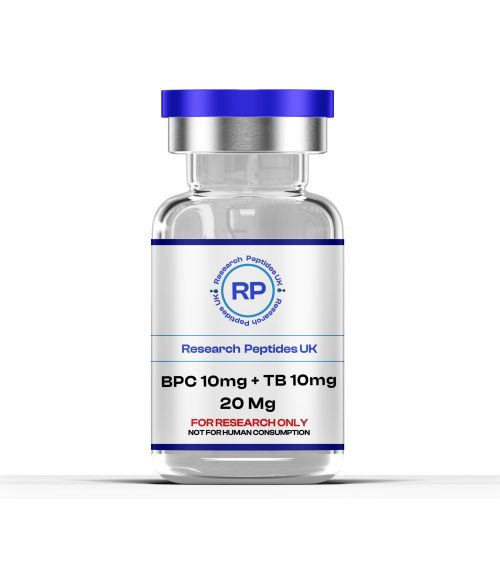
BPC-157 5mg + TB-500 5mg Blend
$108.00
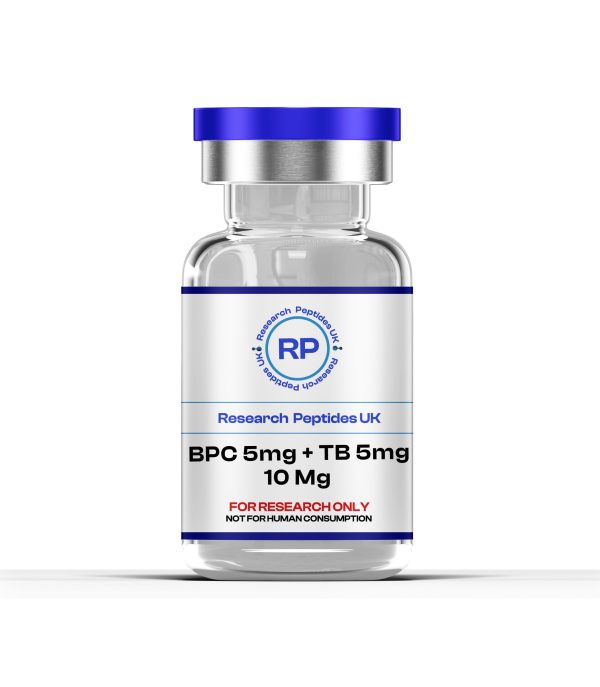
The BPC-157 5mg + TB-500 5mg Blend is a precision-engineered combination of two potent regenerative peptides. This 1:1 ratio provides 5mg of Body Protection Compound-157 and 5mg of Thymosin Beta-4 (TB-500) in a single lyophilized vial.
| Property | Specification |
|---|---|
| Compound A | BPC-157 (5mg) — C₆₂H₉₈N₁₆O₂₂ |
| Compound B | TB-500 / Thymosin Beta-4 (5mg) — C₂₁₂H₃₅₀N₅₆O₇₈S |
| Ratio | 1:1 (BPC-157 : TB-500) |
| Total Vial Content | 10mg lyophilized powder |
| Purity Rating | >99% (HPLC & MS verified, per constituent) |
| Format | White lyophilized powder |
| Solubility | Reconstitutes in bacteriostatic or sterile water |
| Storage | Store at -20°C for long-term stability |
BPC-157 5mg + TB-500 5mg Blend for Sale | 99% Pure 1:1 Wolverine Stack (10mg Total)
If you’re building a tissue-repair study from the ground up, the balanced blend is where most researchers start. The BPC-157 5mg + TB-500 5mg Blend pairs the two most-studied regenerative peptides in a clean 1:1 ratio — equal parts, no weighting toward either mechanism. That symmetry is exactly what makes it the standard comparative baseline: when you want to observe how gastric-derived cytoprotection and actin-driven migration behave together on even footing, this is the vial you reach for.
The pedigree behind each half is deep. BPC-157 carries 180+ peer-reviewed papers and, in rat quadriceps-detachment models, accelerated muscle-to-bone junction repair enough to restore full function (Verified Peptides research notes, 2026). TB-500 controls the cytoskeletal machinery that physically moves repair cells into damaged tissue. One builds the repair environment; the other moves the crew in. On even 1:1 terms, you get to watch both without either dominating the data.
At GLP1 Peptides, we supply the BPC-157 5mg + TB-500 5mg Blend verified to 99%+ purity on each constituent, backed by a batch-specific Certificate of Analysis (COA), and shipped to laboratories across the USA, Canada, Germany, and France. Here’s everything worth knowing.
Research Use Only. This blend is supplied strictly for in-vitro laboratory and analytical research by qualified professionals. It is not a drug, supplement, food, or cosmetic, has not been evaluated by the FDA, and is not intended for human or veterinary use.
What Is the BPC-157 5mg + TB-500 5mg Blend?
This is a single lyophilized vial holding two regenerative peptides in an exact 1:1 ratio — 5mg each, 10mg total.
BPC-157 (Body Protection Compound-157) is a stable 15-amino-acid gastric pentadecapeptide, originally isolated from a protective protein in human gastric juice by Dr. Predrag Sikiric’s lab in 1991 (Loti Labs research review, 2026). TB-500 is a synthetic form of Thymosin Beta-4 (Tβ4), the 43-amino-acid actin-sequestering protein whose LKKTETQ motif governs cell migration.
The 10mg total makes this the practical entry format — enough for focused pilot work and equal-ratio comparisons, without the surplus of a high-yield vial you won’t finish.
How the two peptides coordinate
Here’s the mechanistic logic. BPC-157 modulates the nitric oxide pathway and upregulates VEGF and eNOS (via the Src–Caveolin-1 route), driving angiogenesis and cytoprotection. TB-500 binds monomeric G-actin at roughly 1 μM affinity, regulating the cytoskeletal reorganization that carries cells into wound sites (Loti Labs, 2026). TB-500 also lifts angiogenic proteins including VEGFA, angiopoietin-2, and the Tie2 receptor.
The two don’t compete for the same pathway — they converge on tissue repair from different directions. At a 1:1 ratio, neither side is amplified, which is precisely why this format works as a controlled baseline.
Why Researchers Buy the 1:1 BPC-157 + TB-500 Blend
The balanced format suits coordinated, comparative work. Here’s where it fits:
| Research Focus | What This 1:1 Blend Is Used to Investigate |
|---|---|
| Coordinated Tissue Repair | How BPC-157’s nitric-oxide modulation complements TB-500’s actin-driven cell migration |
| Advanced Angiogenesis | VEGF upregulation through multiple molecular channels |
| ECM Remodeling | Type I collagen deposition and organized tendon, ligament, and muscle repair |
| Systemic vs. Localized Recovery | BPC-157’s systemic stability alongside TB-500’s high mobility |
| Equal-Ratio Baselines | Synergy studies where neither peptide is weighted |
| Pilot-Scale Studies | Focused, lower-volume repair research |
The GLP1 Peptides Quality Standard
A peptide blend is only as reliable as its ratio and its documentation. Here’s what backs every vial:
| Standard | What You Get |
|---|---|
| Verified 99%+ Purity | Each constituent confirmed by HPLC and Mass Spectrometry |
| Homogeneous Synthesis | An exact 1:1 ratio distribution in every vial for consistent variables |
| Analytical Transparency | A batch-specific Certificate of Analysis (COA) ships with every order |
| Stability-Focused Lyophilization | Professional freeze-drying protects both peptide chains for a reliable shelf life |
Technical Product Specifications
| Property | Specification |
|---|---|
| Compound A | BPC-157 (5mg) — C₆₂H₉₈N₁₆O₂₂ |
| Compound B | TB-500 / Thymosin Beta-4 (5mg) — C₂₁₂H₃₅₀N₅₆O₇₈S |
| Ratio | 1:1 (BPC-157 : TB-500) |
| Total Vial Content | 10mg lyophilized powder |
| Purity Rating | >99% (HPLC & MS verified, per constituent) |
| Format | White lyophilized powder |
| Solubility | Reconstitutes in bacteriostatic or sterile water |
| Storage | Store at -20°C for long-term stability |
How to Reconstitute and Store the 1:1 BPC-157 + TB-500 Blend (Laboratory Handling)
Handled well, both peptides stay stable and your 1:1 ratio holds. These are standard in-vitro lab steps — not use directions.
Reconstitution, step by step
| Step | Action |
|---|---|
| 1 | Check your COA and inspect the vial seal, cap, and lyophilized cake |
| 2 | Let the sealed vial reach room temperature to avoid condensation |
| 3 | Add bacteriostatic or sterile water slowly down the inner glass wall — never onto the powder directly |
| 4 | Swirl gently until fully dissolved. Do not shake; agitation shears both peptide chains |
| 5 | Aliquot into single-use portions to protect the blend from freeze-thaw damage |
Storage at a glance
- Lyophilized powder: store at -20°C, sealed, away from heat, light, and moisture. Stable long-term.
- Reconstituted solution: refrigerate at 2–8°C, protect from light, and avoid repeated freeze-thaw cycles.
- Inspect before every use: discard anything cloudy, discolored, or clumped.
Cold, dark, dry, aliquoted. With two peptides sharing one solvent, that discipline is what keeps the 1:1 ratio honest from vial to bench.
1:1 Blend vs 1:2 Blend vs Single Peptides
Buyers cross-shop these formats constantly. Here’s how the balanced 5/5 vial compares.
| Format | Ratio | Emphasis | Best For |
|---|---|---|---|
| BPC-157 5mg + TB-500 5mg | 1:1 | Balanced, neither peptide weighted | Comparative baselines, pilot studies |
| BPC-157 10mg + TB-500 20mg | 1:2 | TB-500-weighted actin/migration | Longitudinal, high-frequency protocols |
| BPC-157 alone | — | Angiogenesis, VEGF, cytoprotection isolated | Single-mechanism studies |
| TB-500 alone | — | Actin dynamics, cell migration isolated | Cytoskeletal-focused studies |
The takeaway: if you want a clean, even starting point — the format that lets you measure combined effects without one peptide dominating — the 1:1 blend is the natural baseline. Step up to the 1:2 vial when your design specifically calls for a heavier TB-500 load.
BPC-157 5mg + TB-500 5mg Blend for Sale — Availability and International Shipping
Ready to add the balanced blend to your study? Our research-grade BPC-157 5mg + TB-500 5mg Blend ships as HPLC/MS-verified, COA-backed lyophilized vials. We serve laboratories and independent researchers across the highest-demand markets:
- 🇺🇸 USA — fast domestic dispatch
- 🇨🇦 Canada — reliable cross-border delivery
- 🇩🇪 Germany (Deutschland) — trusted EU logistics
- 🇫🇷 France — secure European shipping
Every order arrives sealed, documented, and bench-ready. When you buy the BPC-157 5mg + TB-500 5mg Blend from GLP1 Peptides, you’re paying for a verified 1:1 ratio and full data integrity — the foundation any repair study is built on.
FAQs about the BPC-157 5mg + TB-500 5mg Blend
1. What is the BPC-157 5mg + TB-500 5mg Blend? It’s a single lyophilized vial containing 5mg of BPC-157 and 5mg of TB-500 in a 1:1 ratio — 10mg total — supplied for tissue-repair and regenerative research.
2. Why choose the 1:1 ratio? Balance. Equal parts let you study the combined effect of both peptides without weighting the data toward either mechanism, which makes 1:1 the go-to comparative baseline. Choose the 1:2 vial only when you specifically want a heavier TB-500 load.
3. What is the “Wolverine Stack”? It’s the nickname researchers use for the BPC-157 + TB-500 pairing, after the comic character’s rapid healing. This 5/5 vial is the balanced, entry-level version of that stack.
4. How do BPC-157 and TB-500 work together? They don’t compete. BPC-157 drives angiogenesis and cytoprotection through VEGF, eNOS, and nitric-oxide signaling; TB-500 drives cell migration through actin sequestration
5. Is TB-500 the same as Thymosin Beta-4? TB-500 is a synthetic form based on Thymosin Beta-4 (Tβ4), with the LKKTETQ actin-binding region at its core. The terms get used loosely but refer to closely related molecules.
6. Is this blend FDA approved? No. Neither peptide is FDA-approved, and the FDA has flagged that compounded BPC-157 may cause immune reactions with insufficient human safety data. This blend is for laboratory research only.
7. Are BPC-157 and TB-500 banned in sport? Yes. WADA classifies both under Section S0 (non-approved substances), prohibited at all times, with no Therapeutic Use Exemptions. TB-500 / thymosin beta-4 has been banned since 2011
8. How should the blend be stored? Keep the lyophilized powder at -20°C, sealed and away from light and moisture. After reconstitution, refrigerate at 2–8°C, protect from light, and avoid freeze-thaw cycles.
9. How do you reconstitute a two-peptide blend? Bring the vial to room temperature, add bacteriostatic or sterile water down the glass wall, swirl gently, then aliquot. Both peptides dissolve together in the same solvent. Full steps are in the how-to table above.
10. What’s the difference between the 5/5 and the 10/20 blend? Ratio and scale. The 5/5 is a balanced 1:1 baseline at 10mg total; the 10/20 is a TB-500-weighted 1:2 blend at 30mg total for longer, higher-frequency protocols.
11. What purity should the blend be, and how do I verify it? Aim for 99%+ per constituent, confirmed by HPLC and Mass Spectrometry, with a lot-specific COA covering both compounds. Ours ships with exactly that.
12. Where can I buy the BPC-157 5mg + TB-500 5mg Blend that ships internationally? GLP1 Peptides ships the research-grade, COA-verified BPC-157 5mg + TB-500 5mg Blend to the USA, Canada, Germany, and France, in sealed lyophilized vials. Availability details are above.
Verified. Documented. Research-ready. Every vial of the BPC-157 5mg + TB-500 5mg Blend from GLP1 Peptides is HPLC/MS-tested to 99%+ purity per constituent and shipped with a batch-specific COA — because a balanced study starts with a balanced blend you can trust.
Reviews
There are no reviews yet.