Free standard shipping for orders over $340.
BPC 10MG + TP 20MG
$204.00
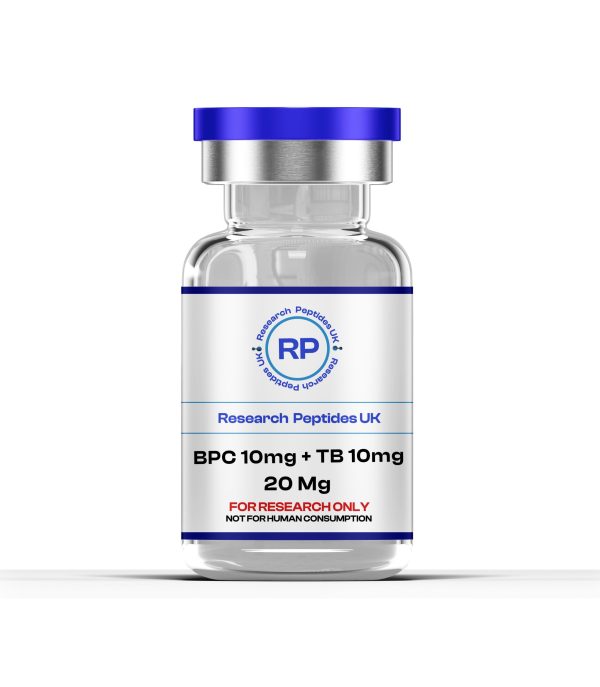
The BPC-157 10mg + TB-500 20mg Blend is a high-capacity combination of two essential regenerative peptides. This specialized 1:2 ratio provides 10mg of Body Protection Compound-157 and 20mg of Thymosin Beta-4 (TB-500) in a single lyophilized vial.
| Property | Specification |
|---|---|
| Compound A | BPC-157 (10mg) — C₆₂H₉₈N₁₆O₂₂ |
| Compound B | TB-500 / Thymosin Beta-4 (20mg) — C₂₁₂H₃₅₀N₅₆O₇₈S |
| Ratio | 1:2 (BPC-157 : TB-500) |
| Total Vial Content | 30mg lyophilized powder |
| Purity Rating | >99% (HPLC & MS verified, per constituent) |
| Format | White lyophilized powder |
| Solubility | Reconstitutes in bacteriostatic or sterile water |
| Storage | Store at -20°C for long-term stability |
BPC-157 10mg + TB-500 20mg Blend for Sale Online | 99% Pure Wolverine Peptide Stack (30mg Total)
Two peptides. Zero overlapping mechanisms. That’s the whole reason the BPC-157 10mg + TB-500 20mg Blend has become one of the most-requested pairings in regenerative research. BPC-157 builds the repair environment — new blood vessels, better perfusion, controlled inflammation. TB-500 moves the repair machinery into place through actin dynamics and cell migration. One sets the stage; the other brings the crew. They attack tissue repair from orthogonal angles, which is exactly why researchers pair them (Loti Labs research review, 2026).
This particular vial runs a 1:2 ratio — 10mg of BPC-157 to 20mg of TB-500 — for a 30mg total payload. The extra TB-500 tilts the blend toward intensified actin-driven responses while keeping BPC-157’s established cytoprotective pathways in play. If you’re running longitudinal studies or high-frequency protocols where a standard 1:1 vial empties too fast, this is the format built for you.
At GLP1 Peptides, we supply the BPC-157 10mg + TB-500 20mg Blend verified to 99%+ purity on each constituent, backed by a batch-specific Certificate of Analysis (COA), and shipped to laboratories across the USA, Canada, Germany, and France. Here’s the full breakdown.
Research Use Only. This blend is supplied strictly for in-vitro laboratory and analytical research by qualified professionals. It is not a drug, supplement, food, or cosmetic, has not been evaluated by the FDA, and is not intended for human or veterinary use.
What Is the BPC-157 10mg + TB-500 20mg Blend?
This is a single lyophilized vial holding two regenerative peptides in a fixed 1:2 ratio.
BPC-157 (Body Protection Compound-157) is a stable 15-amino-acid gastric pentadecapeptide, originally isolated from a protective protein in human gastric juice by Dr. Predrag Sikiric’s lab in 1991. Since then it’s accumulated over 180 peer-reviewed papers across cytoprotection, angiogenesis, and anti-inflammatory models (Loti Labs, 2026).
TB-500 is a synthetic version of Thymosin Beta-4 (Tβ4), a 43-amino-acid actin-sequestering protein first characterized in the 1960s from thymus tissue. Its signature LKKTETQ motif is the part that grabs G-actin and governs cell migration.
How the two peptides work together
Here’s the mechanistic logic, and it’s genuinely elegant. BPC-157 upregulates VEGF and endothelial nitric oxide synthase (eNOS), driving angiogenesis and cytoprotection through the nitric-oxide system. TB-500 binds monomeric G-actin (at roughly 1 μM affinity), controlling how much actin is available for the cytoskeletal reorganization that moves cells into damaged tissue (Loti Labs, 2026). TB-500 also lifts angiogenic proteins like VEGFA, angiopoietin-2, and the Tie2 receptor, apparently through Notch and NF-κB signaling.
BPC-157 increases actin production at the genetic level; TB-500 organizes that actin into functional structures. Researchers describe it as a biological “one-two punch” — and the 1:2 ratio here leans into the TB-500 side of that punch.
Why Researchers Buy the BPC-157 + TB-500 30mg Blend
The high-yield format suits extensive, multi-variable work. Here’s where it fits:
| Research Focus | What This Blend Is Used to Investigate |
|---|---|
| Intensified Angiogenesis | Cumulative effect of both peptides on VEGF upregulation and capillary sprout formation |
| Accelerated Myofibrillar Repair | Synergy between TB-500’s actin binding and BPC-157’s growth-factor influence in muscle tissue |
| Extensive ECM Modulation | Type I and Type III collagen deposition in severe soft-tissue models |
| Systemic Recovery Dynamics | Biological half-life and mobility of both compounds at high-concentration ratios |
| Tendon & Ligament Models | Fibroblast activity and tendon-to-bone integration in musculoskeletal research |
| Inflammation Modulation | Combined downregulation of TNF-α and IL-6 across tissue types |
The GLP1 Peptides Quality Standard
A peptide blend is only as reliable as its ratio and its documentation. Here’s what backs every vial:
| Standard | What You Get |
|---|---|
| Verified 99%+ Purity | Each constituent confirmed by HPLC and Mass Spectrometry |
| Precision Ratio Formulation | A consistent 1:2 molecular distribution in every vial for data integrity |
| Analytical Transparency | A batch-specific Certificate of Analysis (COA) ships with every order |
| Superior Lyophilization | Professional freeze-drying stabilizes both peptide chains against enzymatic degradation |
Technical Product Specifications
| Property | Specification |
|---|---|
| Compound A | BPC-157 (10mg) — C₆₂H₉₈N₁₆O₂₂ |
| Compound B | TB-500 / Thymosin Beta-4 (20mg) — C₂₁₂H₃₅₀N₅₆O₇₈S |
| Ratio | 1:2 (BPC-157 : TB-500) |
| Total Vial Content | 30mg lyophilized powder |
| Purity Rating | >99% (HPLC & MS verified, per constituent) |
| Format | White lyophilized powder |
| Solubility | Reconstitutes in bacteriostatic or sterile water |
| Storage | Store at -20°C for long-term stability |
How to Reconstitute and Store the BPC-157 10mg + TB-500 Blend (Laboratory Handling)
A 30mg blend vial is a serious investment, so handling it properly protects both peptides at once. These are standard in-vitro lab steps — not use directions.
Reconstitution, step by step
| Step | Action |
|---|---|
| 1 | Check your COA and inspect the vial seal, cap, and lyophilized cake |
| 2 | Let the sealed vial reach room temperature to avoid condensation |
| 3 | Add bacteriostatic or sterile water slowly down the inner glass wall — never blast the powder directly |
| 4 | Swirl gently until fully dissolved. Do not shake; agitation shears both peptide chains |
| 5 | Aliquot into single-use portions — with two peptides and 30mg total, freeze-thaw discipline matters more, not less |
Storage at a glance
- Lyophilized powder: store at -20°C, sealed, away from heat, light, and moisture. Stable long-term.
- Reconstituted solution: refrigerate at 2–8°C, protect from light, and avoid repeated freeze-thaw cycles.
- Inspect before every use: discard anything cloudy, discolored, or clumped.
Cold, dark, dry, aliquoted. With a dual-peptide blend, that discipline is what keeps your 1:2 ratio intact from vial to bench.
This 1:2 Blend vs Other BPC-157 & TB-500 Research Formats
Buyers cross-shop these formats constantly. Here’s how the 10/20 vial compares.
| Format | Ratio | Emphasis | Best For |
|---|---|---|---|
| BPC-157 10mg + TB-500 20mg | 1:2 | Intensified actin/migration + established cytoprotection | Longitudinal, high-frequency protocols |
| BPC-157 + TB-500 (1:1) | 1:1 | Balanced additive study | Comparative synergy baselines |
| BPC-157 alone | — | Angiogenesis, VEGF, cytoprotection isolated | Single-mechanism studies |
| TB-500 alone | — | Actin dynamics, cell migration isolated | Cytoskeletal-focused studies |
The takeaway: if your design calls for a heavier TB-500 load — more actin-driven signaling per vial — this 1:2 format delivers it without forcing you to co-reconstitute two separate compounds.
BPC-157 10mg + TB-500 20mg Blend for Sale | Availability and International Shipping
Ready to stock up for an extended study? Our research-grade BPC-157 10mg + TB-500 20mg Blend ships as HPLC/MS-verified, COA-backed lyophilized vials. We serve laboratories and independent researchers across the highest-demand markets:
- 🇺🇸 USA — fast domestic dispatch
- 🇨🇦 Canada — reliable cross-border delivery
- 🇩🇪 Germany (Deutschland) — trusted EU logistics
- 🇫🇷 France — secure European shipping
- Global Shipping
Every order arrives sealed, documented, and bench-ready. When you buy the BPC-157 10mg + TB-500 20mg Blend from GLP1 Peptides, you’re paying for a verified 1:2 ratio and full data integrity — the two things that decide whether a dual-peptide study holds up.
FAQs about the BPC-157 + TB-500 Blend
1. What is the BPC-157 10mg + TB-500 20mg Blend? It’s a single lyophilized vial containing 10mg of BPC-157 and 20mg of TB-500 in a 1:2 ratio — 30mg total — supplied for tissue-repair and regenerative research.
2. Why the 1:2 ratio instead of 1:1? The heavier TB-500 load emphasizes actin-driven cell migration and angiogenic signaling per vial, while keeping BPC-157’s cytoprotective pathways active. It’s built for protocols that lean on the TB-500 side of the mechanism.
3. What is the “Wolverine Stack”? It’s the nickname researchers use for the BPC-157 + TB-500 pairing, after the comic-book character’s rapid healing. This vial is the high-yield version of that stack.
4. How do BPC-157 and TB-500 work together? They don’t compete. BPC-157 drives angiogenesis through VEGF and eNOS; TB-500 drives cell migration through actin sequestration. One creates the repair environment, the other moves cells into it.
5. Is TB-500 the same as Thymosin Beta-4? TB-500 is a synthetic form based on Thymosin Beta-4 (Tβ4). The active actin-binding region is the LKKTETQ sequence. The terms get used loosely, but they refer to closely related molecules.
6. Is the BPC-157 + TB-500 blend FDA approved? No. Neither peptide is FDA-approved, and the FDA has flagged that compounded BPC-157 may cause immune reactions with insufficient human safety data. This blend is for laboratory research only.
7. Are BPC-157 and TB-500 banned in sport? Yes. WADA classifies both under Section S0 (non-approved substances), prohibited at all times, with no Therapeutic Use Exemptions. TB-500 / thymosin beta-4 has been explicitly banned since 2011. Athletes subject to testing should take note.
8. How should the blend be stored? Keep the lyophilized powder at -20°C, sealed and away from light and moisture. After reconstitution, refrigerate at 2–8°C, protect from light, and avoid freeze-thaw cycles.
9. How do you reconstitute a two-peptide blend? Exactly like a single peptide — bring to room temperature, add bacteriostatic or sterile water down the glass wall, swirl gently, then aliquot. Both peptides dissolve together in the same solvent. Full steps are in the how-to table above.
10. What purity should the blend be, and how do I verify it? Aim for 99%+ per constituent, confirmed by HPLC and Mass Spectrometry, with a lot-specific COA covering both compounds. Ours ships with exactly that.
11. Can I study each peptide’s effect separately from a blend? Partly — a fixed blend is best for studying combined effects. If you need to isolate one mechanism, single-compound vials give you cleaner variable control. The comparison table above lays out when each format makes sense.
12. Where can I buy the BPC-157 10mg + TB-500 blend that ships internationally? GLP1 Peptides ships the research-grade, COA-verified BPC-157 10mg + TB-500 20mg Blend to the USA, Canada, Germany, and France, in sealed lyophilized vials. Availability details are above.
Verified. Documented. Research-ready. Every vial of the BPC-157 10mg + TB-500 20mg Blend from GLP1 Peptides is HPLC/MS-tested to 99%+ purity per constituent and shipped with a batch-specific COA — because a dual-peptide study is only as good as the ratio behind it.
Reviews
There are no reviews yet.