Free standard shipping for orders over $340.

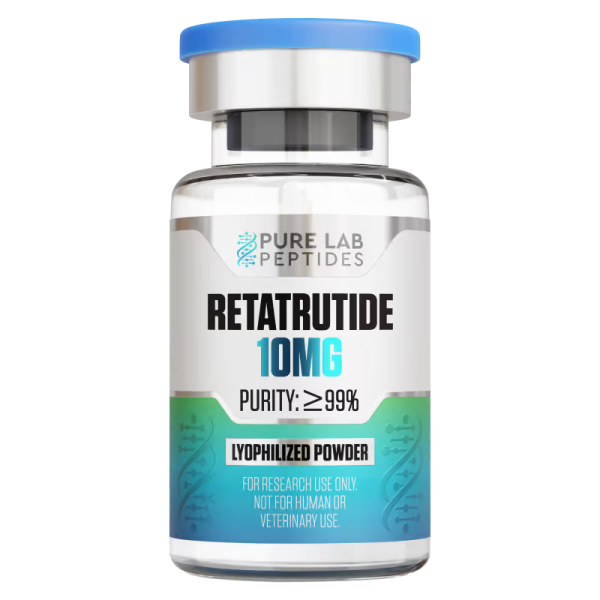
Retatrutide
$96.00
Retatrutide is a next-generation “triple agonist” peptide synthesized for advanced metabolic and endocrine research. Each vial contains high-purity Retatrutide, designed to target GLP-1, GIP, and Glucagon receptors simultaneously. This research-grade compound is lyophilized to ensure maximum structural integrity and consistent results in academic and institutional studies.
| Property | Specification |
|---|---|
| Compound Name | Retatrutide |
| Development Code | LY3437943 |
| Class | Unimolecular triple agonist (GLP-1 / GIP / Glucagon) |
| Structure | Single peptide conjugated to a fatty-diacid moiety (acylated) |
| Target Receptors | GLP-1R, GIPR, GCGR |
| Administration Profile | Long half-life supporting once-weekly-style dosing (research context) |
| Purity Rating | >99% (HPLC & MS verified) |
| Format | White lyophilized crystalline powder |
| Storage | -20°C for long-term stability |
Top Retatrutide for Sale | 99% Pure GLP-1/GIP/Glucagon Triple Agonist (LY3437943)
In 2023, one compound made the entire obesity-research field sit up. In a Phase 2 trial published in the New England Journal of Medicine, adults on the highest dose of Retatrutide lost a mean of 24.2% of their body weight over 48 weeks — the largest reduction ever recorded for this class of molecule. Headlines called it what it was: “this raises the bar.” Nearly two-thirds of participants at that dose lost 20% or more of their body weight (Healio, 2023).
Retatrutide (Eli Lilly’s LY3437943) is the furthest-advanced “triple agonist” in metabolic science — a single peptide that hits three receptors at once. This is the research-grade version: 99%+ pure, lyophilized, and built for serious metabolic and endocrine research. It’s one of the most sought-after compounds in the field right now, and below I’ll show you exactly why, how to work with it, and where to buy it.
Scope note: research-grade material for in-vitro and laboratory research by qualified professionals only. Retatrutide is an investigational compound (not the FDA-approved branded drug), not for human or veterinary use, and nothing here is a dosing protocol.
Why Retatrutide Raised the Bar
The obesity-drug story moved fast: first single GLP-1 agonists (semaglutide), then dual GLP-1/GIP agonists (tirzepatide), and now the triple. What makes Retatrutide different — and what drove those record numbers — is that third receptor.
Where dual agonists work two levers to reduce calorie intake, Retatrutide adds glucagon-receptor agonism, which layers increased energy expenditure on top. In other words, it doesn’t just turn down the input — it turns up the burn. A 2022 Cell Metabolism paper from Lilly’s team (Coskun et al.) described its balanced glucagon and GLP-1 activity with more prominent GIP activity, and even documented persistent weight loss lasting 43 days post-dose in animal models. That combination is why researchers consider it a genuine evolution in the class, not just an incremental step.
The Triple-Agonist Mechanism
Retatrutide is a single acylated peptide (conjugated to a fatty-diacid moiety for a long, once-weekly-style half-life) that engages three distinct receptors simultaneously:
- GLP-1 receptor — suppresses appetite, slows gastric emptying, boosts insulin secretion
- GIP receptor — enhances incretin signaling and insulin response
- Glucagon receptor (GCGR) — increases energy expenditure and influences hepatic metabolism
Individually, each pathway is a legitimate metabolic target. Together, they produce an additive effect that neither single nor dual agonists reach — which is exactly what makes Retatrutide such a valuable tool for studying complex, multi-receptor metabolic signaling and energy homeostasis.
What the Clinical Data Shows
The human trial record behind Retatrutide is unusually strong for a research compound. Here are the real numbers.
| Finding | Result | Trial / Context | Source |
|---|---|---|---|
| Peak weight loss | 24.2% vs 2.1% placebo (48 wks, 12 mg) | Phase 2 obesity RCT, n=338 | NEJM, 2023 |
| ≥20% weight loss | ~two-thirds of participants (12 mg) | Phase 2 | Healio, 2023 |
| ≥30% weight loss | ~one-quarter of participants (12 mg) | Phase 2 | Healio, 2023 |
| Placebo-adjusted loss | 16% at 24 wks; 22% at 48 wks | Phase 2 (12 mg) | PACE-CME, 2023 |
| Type 2 diabetes | Improved HbA1c + robust weight loss | Phase 2 T2D trial | Rosenstock et al., Lancet, 2023 |
| Durability | Weight loss persisted 43 days post-dose | Animal models | Superpower, 2026 |
An honest status note: those figures come from Eli Lilly’s clinical program using the therapeutic 12 mg dose. Retatrutide is investigational — Phase 3 (the TRIUMPH program) has been the next step, and it isn’t the finished, approved drug. The data explains the scientific excitement; it doesn’t make a research vial a medicine. (This field moves fast, so verify current regulatory status.)
Retatrutide vs Semaglutide vs Tirzepatide
This is the comparison every buyer wants, so here it is straight.
| Compound | Receptors | Class | Peak Phase 2/3 Weight Loss* |
|---|---|---|---|
| Retatrutide (this product) | GLP-1 + GIP + Glucagon | Triple agonist | ~24% |
| Tirzepatide | GLP-1 + GIP | Dual agonist | ~21% |
| Semaglutide | GLP-1 | Single agonist | ~15% |
| Native GLP-1 | GLP-1 | Endogenous hormone | — |
Trial figures vary by study, dose, and population; shown for research context.
The clean takeaway: Retatrutide‘s added glucagon arm is what pushes it past the dual and single agonists in trial data — more receptors engaged, more metabolic levers pulled (Superpower, 2026). For researchers comparing incretin-based mechanisms, it’s the most complete member of the family to study.
Where Retatrutide Fits in Research
| Research Focus | What’s Being Investigated |
|---|---|
| Multi-Receptor Signaling | Simultaneous GLP-1, GIP, and glucagon receptor activation |
| Energy Homeostasis | The glucagon-driven energy-expenditure component |
| Glucose Regulation | Incretin effects on insulin and glycemic control |
| Comparative Pharmacology | Triple vs dual vs single agonist profiles |
| Hepatic Metabolism | Liver-fat and metabolic-dysfunction models (MASLD) |
Why Buy Research-Grade Retatrutide From GLP1 Peptides
| Standard | What It Means for Your Research |
|---|---|
| 99%+ Purity | HPLC and Mass Spectrometry verify every batch |
| Advanced Lyophilization | Freeze-drying that protects the acylated peptide’s bonds |
| Batch-Specific COA | Full analytical documentation with every order |
| Precision Synthesis | Exact sequencing for a complex, multi-domain peptide |
Retatrutide is a sophisticated acylated peptide — sequence and identity really matter. A verified COA is what tells you the compound in your vial is genuine, correctly synthesized Retatrutide, not a degraded or mislabeled substitute.
How to Reconstitute Retatrutide (Step by Step)
You asked for the how-to, so here’s the full walkthrough. As an acylated peptide, Retatrutide needs gentle handling to stay intact.
| Step | What to Do |
|---|---|
| 1 | Let the sealed vial reach room temperature to avoid condensation |
| 2 | Use sterile or bacteriostatic water as your reconstitution solvent |
| 3 | Add the solvent slowly down the inner glass wall — never squirt it onto the powder |
| 4 | Swirl gently until fully dissolved; do not shake, which shears the peptide |
| 5 | Let it settle until the solution is clear |
| 6 | Aliquot into single-use portions to avoid repeated freeze-thaw |
How to Store Retatrutide
- Lyophilized powder: store at -20°C, sealed and away from light and moisture — stable long-term.
- Reconstituted solution: keep at 2–8°C, protect from light, and use within a few weeks.
- Freeze-thaw: avoid repeated cycles — aliquot first to protect the whole vial.
- Inspect: the solution should be clear; discard anything cloudy or discolored.
Cold, dark, gentle, aliquoted — with an acylated peptide this valuable, careful handling is simply protecting your investment.
Technical Specifications
| Property | Specification |
|---|---|
| Compound Name | Retatrutide |
| Development Code | LY3437943 |
| Class | Unimolecular triple agonist (GLP-1 / GIP / Glucagon) |
| Structure | Single peptide conjugated to a fatty-diacid moiety (acylated) |
| Target Receptors | GLP-1R, GIPR, GCGR |
| Administration Profile | Long half-life supporting once-weekly-style dosing (research context) |
| Purity Rating | >99% (HPLC & MS verified) |
| Format | White lyophilized crystalline powder |
| Storage | -20°C for long-term stability |
Retatrutide for Sale — Shipping Worldwide
Our research-grade Retatrutide ships as HPLC/MS-verified, COA-backed lyophilized vials, sealed and bench-ready. We fulfill orders for laboratories and independent researchers across the highest-demand markets:
- 🇺🇸 USA — fast domestic dispatch
- 🇨🇦 Canada — reliable cross-border delivery
- 🇩🇪 Germany (Deutschland) — trusted EU logistics
- 🇫🇷 France — secure European shipping
Ready to work with the most advanced triple agonist in metabolic research? When you buy Retatrutide from GLP1 Peptides, you’re getting a verified, high-purity peptide backed by full documentation — the identity assurance that serious, publishable metabolic research demands.
FAQs about Retatrutide
1. What is Retatrutide? A next-generation “triple agonist” peptide (Eli Lilly’s LY3437943) that simultaneously activates the GLP-1, GIP, and glucagon receptors, supplied as a lyophilized powder for metabolic and endocrine research.
2. What makes Retatrutide a “triple agonist”? It engages three receptors at once — GLP-1 and GIP (which reduce calorie intake) plus glucagon (which increases energy expenditure) — where earlier drugs hit only one or two
3. How does Retatrutide compare to tirzepatide and semaglutide? Semaglutide is a single (GLP-1) agonist; tirzepatide is a dual (GLP-1/GIP) agonist; Retatrutide adds the glucagon receptor as a third target — and produced the highest weight-loss figures of the three in trials.
4. What did the Phase 2 trial show? At the 12 mg dose over 48 weeks, mean weight loss was 24.2% versus 2.1% for placebo, with roughly two-thirds of participants losing ≥20%.
5. Why does the glucagon receptor matter? Because glucagon-receptor agonism raises energy expenditure, adding a “burn more” mechanism on top of the “eat less” effects of GLP-1 and GIP — which is credited for Retatrutide’s larger effect.
6. Is Retatrutide FDA approved? No. It’s an investigational compound in Eli Lilly’s clinical pipeline and isn’t approved. This research-grade material is for laboratory use only, not the branded drug. (Regulatory status can change — verify current status.)
7. Is Retatrutide the same as the pharmaceutical version? No. The research-grade powder shares the peptide’s identity but is not the finished, formulated, approved pharmaceutical, and is not for human use.
8. How do you reconstitute Retatrutide? Warm the vial, add sterile or bacteriostatic water slowly down the glass wall, swirl gently (never shake), then aliquot. Full steps are in the how-to table above.
9. How should Retatrutide be stored? Lyophilized powder at -20°C, sealed and dark; reconstituted solution at 2–8°C, protected from light, with freeze-thaw cycles avoided.
10. Why is Retatrutide acylated? The fatty-diacid conjugation binds albumin and extends its half-life, which is what supports infrequent, once-weekly-style administration in research settings.
11. What purity should Retatrutide be? Aim for 99%+ verified by HPLC and Mass Spectrometry, with a lot-specific COA confirming identity. Ours ships with exactly that.
12. Where can I buy Retatrutide internationally? GLP1 Peptides ships research-grade, COA-verified Retatrutide to the USA, Canada, Germany, and France in sealed lyophilized vials.
Reviews
There are no reviews yet.