Free standard shipping for orders over $340.
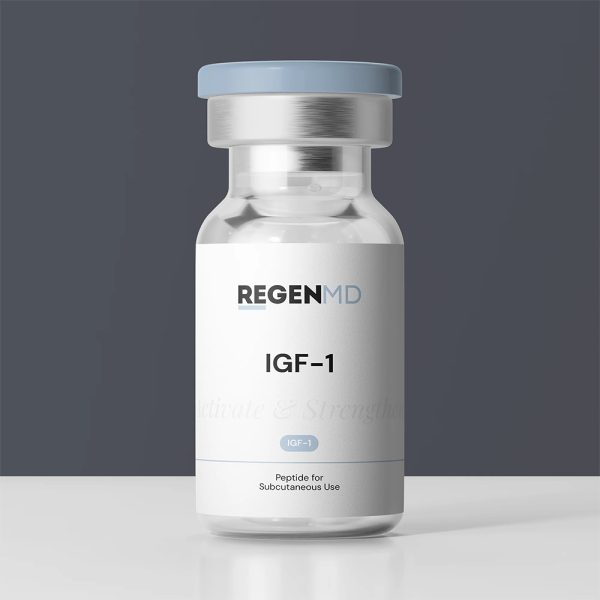
IGF-1 LR3 Peptide
$187.00
IGF-1 LR3 Peptide is a synthetic, 83-amino acid analog of human Insulin-like Growth Factor-1 (IGF-1). Specifically engineered for research applications, this analog includes an Arginine substitution at position 3 and a 13-amino acid extension at the N-terminus. These modifications significantly decrease binding to IGF-binding proteins (IGFBPs), resulting in increased potency and a vastly extended biological half-life in laboratory models.
| Property | Specification |
|---|---|
| Compound Name | Long R3 IGF-1 (IGF-1 LR3) |
| CAS Number | 946870-92-4 |
| Amino Acid Count | 83 (70 native + 13 N-terminal extension) |
| Modifications | Arg substitution at position 3; 13-residue N-terminal extension |
| Molecular Weight | ~9.1 kDa |
| Receptor Target | IGF-1 receptor (IGF1R) — affinity similar to native IGF-1 |
| Free Fraction | 70–90% unbound in plasma |
| Relative Potency | ~1.5–2× native IGF-1 |
| Purity Rating | >99% (HPLC & MS verified) |
| Format | White lyophilized powder |
| Reconstitution | Sterile or bacteriostatic water (0.6% acetic acid also used for solubility) |
| Storage | -20°C; avoid repeated freeze-thaw after reconstitution |
IGF-1 LR3 for Sale | 99% Pure Long R3 Growth Factor Analog for Research
Native IGF-1 has a problem: your body keeps it on a leash. Under normal conditions, less than 1% of circulating IGF-1 is actually free to do anything, the rest is captured by IGF-binding proteins that hold it in reserve (Real Peptides research review, 2026). IGF-1 LR3 was engineered to slip that leash. By dodging the binding proteins almost entirely, it stays 70–90% unbound and receptor-available, orders of magnitude more free, active growth factor than native IGF-1 delivers.
That single change makes IGF-1 LR3 (Long R3 IGF-1) one of the most-used growth-factor tools in molecular biology, from myoblast proliferation assays to industrial cell-culture media. It’s also a compound wrapped in a lot of internet myth, so this page gives you the accurate version, mechanism, real data, honest caveats, and where to buy it.
Scope note: research-grade material for in-vitro and laboratory use by qualified professionals only. Not FDA-approved, not for human or veterinary use, and nothing here is a dosing protocol. All properties described are preclinical.
The Long R3 Modification: What It Actually Changes
IGF-1 LR3 is an 83-amino-acid analog of the native 70-residue IGF-1, and it carries two deliberate structural edits:
- An arginine substitution at position 3 (replacing glutamic acid), which disrupts the binding interface with IGFBP-3 and cuts binding-protein affinity by roughly 100-fold.
- A 13-amino-acid N-terminal extension, which sterically blocks IGFBP interaction further (Real Peptides, 2026).
Here’s the key point that a lot of write-ups miss: those edits sit on the IGFBP-binding surface, not the receptor-binding surface. So LR3 binds the IGF-1 receptor (IGF1R) with affinity similar to native IGF-1 — the receptor-level pharmacology is preserved — while the binding-protein behavior is transformed. More free ligand, same receptor. That’s the whole design.
Setting the Record Straight on “Half-Life”
You’ll see IGF-1 LR3 marketed everywhere as having a “vastly extended half-life” — often quoted as 20–30 hours. I’d be doing you a disservice to repeat that without a caveat, because the primary literature tells a more nuanced story.
What’s genuinely true: LR3 produces sustained IGF1R activation in cell culture and a much larger free, active fraction, because it isn’t sequestered by binding proteins. What’s contested: whether it circulates longer in vivo. IGFBP-3 normally forms a protective complex that shields IGF-1 from clearance — and because LR3 can’t bind that complex, some primary animal studies report it’s actually cleared faster than native IGF-1, not slower (PMID 7693845, via Peptpedia, 2026). Its measured potency advantage is roughly 1.5–2× native IGF-1 (PMID 8708565).
The honest framing, then: LR3’s edge is a higher free fraction and greater potency, giving sustained receptor engagement in culture with practical once-daily dosing in models — not necessarily a longer bloodstream half-life. That’s the version that holds up to scrutiny.
How IGF-1 LR3 Signals
Once IGF-1 LR3 binds IGF1R (a receptor tyrosine kinase), the receptor autophosphorylates and recruits IRS-1, splitting into two dominant cascades):
- PI3K/Akt/mTOR — the master regulator of protein synthesis. It phosphorylates Akt, TSC2, and mTORC1, activating p70S6K and inhibiting 4E-BP1 to ramp up ribosomal translation, while suppressing FOXO1 to reduce protein breakdown. It also drives glucose uptake via GLUT4 translocation. A dual anabolic push: build more, break down less.
- MAPK/ERK — the proliferation-and-differentiation arm, driving cell division and survival.
Together these are the mechanistic core of the hyperplasia (new cells) and hypertrophy (enlarged cells) research LR3 is known for.
Where IGF-1 LR3 Fits in Research
| Research Focus | What’s Being Investigated |
|---|---|
| Hyperplasia & Hypertrophy | Cellular division and growth in myoblast (L6, C2C12) models |
| Protein Synthesis | AKT/mTOR activation, p70S6K, and satellite-cell proliferation |
| Glucose Metabolism | Insulin-like GLUT4-mediated nutrient uptake |
| Cell-Culture Media Supplement | Supporting CHO and other industrial cell lines (typically 1–100 ng/mL) |
| Cachexia & Protein-Metabolism Models | Longer-acting, more potent alternative to native IGF-1 in rodents |
| Neuroprotection & Bone Physiology | IGF1R signaling in neuronal and osteoblast research |
That cell-culture line matters, by the way, supplementing growth media is one of the single most common, legitimate uses of IGF-1 LR3 in labs worldwide.
The Evidence, By the Numbers
| Finding | Value | Context | Source |
|---|---|---|---|
| Free/unbound fraction | 70–90% (vs <1% native) | Plasma binding | Real Peptides, 2026 |
| IGFBP-3 affinity reduction | ~100-fold lower | Arg3 + N-terminal extension | Real Peptides, 2026 |
| Potency vs native IGF-1 | ~1.5–2× | In-vivo bioactivity (PMID 8708565) | Peptpedia, 2026 |
| In-vivo clearance | Faster than native (contested) | Animal models (PMID 7693845) | Peptpedia, 2026 |
| Human PK data | None published | All properties preclinical | Peptpedia, 2026 |
Research Considerations Worth Knowing
Powerful signaling cuts both ways, and honest documentation matters. The same PI3K/Akt anti-apoptotic activity that preserves muscle cells also protects pre-malignant cells — so while LR3 doesn’t cause cancer, research notes it can accelerate existing malignancies by suppressing pro-apoptotic proteins. Its insulin-like activity can drop glucose sharply, and in a 7-day guinea-pig infusion study, systemic LR3 suppressed endogenous IGF-I, IGF-II, and IGFBP-3 through negative feedback on the GH-IGF axis (PMID 7561636). These aren’t marketing points — they’re exactly the mechanisms that make LR3 a serious research subject, and reasons it belongs strictly in a controlled lab.
Expanded Technical Specifications
| Property | Specification |
|---|---|
| Compound Name | Long R3 IGF-1 (IGF-1 LR3) |
| CAS Number | 946870-92-4 |
| Amino Acid Count | 83 (70 native + 13 N-terminal extension) |
| Modifications | Arg substitution at position 3; 13-residue N-terminal extension |
| Molecular Weight | ~9.1 kDa |
| Receptor Target | IGF-1 receptor (IGF1R) — affinity similar to native IGF-1 |
| Free Fraction | 70–90% unbound in plasma |
| Relative Potency | ~1.5–2× native IGF-1 |
| Purity Rating | >99% (HPLC & MS verified) |
| Format | White lyophilized powder |
| Reconstitution | Sterile or bacteriostatic water (0.6% acetic acid also used for solubility) |
| Storage | -20°C; avoid repeated freeze-thaw after reconstitution |
The GLP1 Peptides Quality Standard
| Standard | What You Get |
|---|---|
| Verified 99%+ Purity | Every batch confirmed by HPLC and Mass Spectrometry |
| Professional Lyophilization | Freeze-drying that protects the complex 83-residue chain |
| Analytical Transparency | A batch-specific Certificate of Analysis (COA) with every order |
| Sequence Accuracy | Exact molecular sequencing for reproducible results |
For a modified growth factor, that COA is doing real work — it confirms you have genuine LR3 (with both modifications intact), not native IGF-1 or a mislabeled analog.
Reconstituting IGF-1 LR3 in the Lab
IGF-1 LR3 is a folded protein, so treat it gently. Bring the sealed vial to room temperature, then add your solvent slowly down the inner glass wall — many labs use sterile or bacteriostatic water, though a mild acetic-acid solution improves solubility for this particular analog. Swirl gently until dissolved; never shake, since agitation denatures growth factors. Aliquot into single-use portions right away.
Store the lyophilized powder at -20°C. Once reconstituted, keep it cold, protect it from light, and — critically for this compound — avoid repeated freeze-thaw cycles, which degrade it quickly. Cloudy or discolored solution gets retired.
IGF-1 LR3 vs Native IGF-1 vs Other Analogs
| Compound | Key Feature | Research Profile |
|---|---|---|
| IGF-1 LR3 (this product) | Arg3 + N-terminal extension; evades IGFBPs | High free fraction, ~1.5–2× potency, sustained IGF1R activation in culture |
| Native IGF-1 | Unmodified | <1% free; short bioactive window; binding-protein regulated |
| IGF-1 DES | Missing first 3 N-terminal residues | Very short-acting; high local potency |
| HGH 191aa | Upstream hormone | Induces endogenous IGF-1; broader two-track GH effects |
The clean distinction: IGF-1 LR3 exists to keep IGF-1 free and active where native IGF-1 gets sequestered. If your research needs sustained, potent IGF1R activation in a binding-protein-rich environment like serum-containing culture, it’s the purpose-built tool.
IGF-1 LR3 for Sale — Shipping Worldwide
Our research-grade IGF-1 LR3 ships as HPLC/MS-verified, COA-backed lyophilized vials, sealed and bench-ready. We fulfill orders for laboratories and independent researchers across the highest-demand markets:
- 🇺🇸 USA — fast domestic dispatch
- 🇨🇦 Canada — reliable cross-border delivery
- 🇩🇪 Germany (Deutschland) — trusted EU logistics
- 🇫🇷 France — secure European shipping
When you buy IGF-1 LR3 from GLP1 Peptides, you’re getting a verified analog with both structural modifications confirmed — because for a growth factor whose entire value rides on those two edits, identity verification is the product.
FAQs about IGF-1 LR3
1. What is IGF-1 LR3? An 83-amino-acid synthetic analog of human IGF-1 with an Arg3 substitution and a 13-residue N-terminal extension, supplied as a lyophilized powder for growth-factor and cell-signaling research.
2. What does the “Long R3” modification do? It sharply lowers binding-protein affinity (~100-fold), so most of the molecule stays free and receptor-available instead of being sequestered like native IGF-1.
3. Does IGF-1 LR3 really have an extended half-life? It’s widely claimed, but the picture is nuanced. LR3 gives sustained receptor activation in culture and a much higher free fraction, yet some primary animal studies show it clears faster in vivo because it can’t bind protective IGFBP-3.. The real edge is potency and free availability, not necessarily longer circulation.
4. How much more potent is it than native IGF-1? Roughly 1.5–2× in bioactivity assays (PMID 8708565), driven by the larger free, receptor-available fraction.
5. How does IGF-1 LR3 work? It binds IGF1R and activates the PI3K/Akt/mTOR pathway (protein synthesis, glucose uptake, anti-atrophy) and the MAPK/ERK pathway (proliferation, differentiation).
6. What’s a common lab use for IGF-1 LR3? Beyond myoblast and satellite-cell research, it’s widely used as a cell-culture media supplement (typically 1–100 ng/mL) to support CHO and other industrial cell lines.
7. Are there safety considerations in research models? Yes — its anti-apoptotic signaling can protect pre-malignant cells and accelerate existing malignancies, it can lower glucose sharply, and it suppresses the endogenous GH-IGF axis via feedback. Handle it as the potent research compound it is.
8. Is IGF-1 LR3 FDA approved? No. It’s research-only, not approved for human use, and there’s no published human pharmacokinetic data.
9. Is it banned in sport? Yes — IGF-1 and its analogs fall under WADA’s S2 category, prohibited in and out of competition.
10. How should IGF-1 LR3 be stored? Lyophilized powder at -20°C; reconstituted solution kept cold, dark, and — importantly — protected from repeated freeze-thaw cycles, which degrade it fast.
11. How do you reconstitute IGF-1 LR3? Room-temperature vial, sterile/bacteriostatic water (or mild acetic acid for solubility) added slowly down the glass wall, gentle swirl, then aliquot. The handling section covers it.
12. Where can I buy IGF-1 LR3 internationally? GLP1 Peptides ships research-grade, COA-verified IGF-1 LR3 to the USA, Canada, Germany, and France in sealed lyophilized vials.
Reviews
There are no reviews yet.