Free standard shipping for orders over $340.

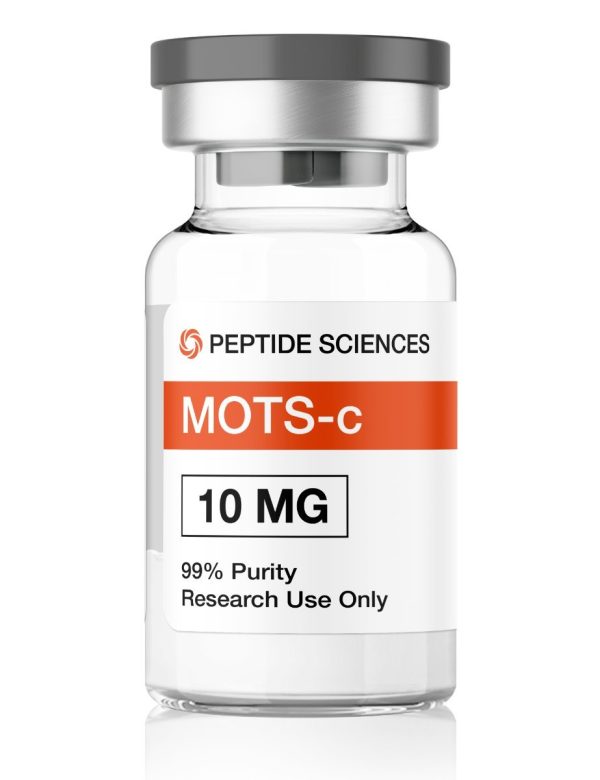
MOTS-c (10mg)
$60.00
MOTS-c 10mg is a cutting-edge mitochondrial-derived peptide (MDP) synthesized for academic and institutional research. Each vial contains 10mg of high-purity MOTS-c, a 16-amino acid peptide known for its role in metabolic regulation. This product is lyophilized to ensure maximum structural integrity and long-term stability in laboratory environments.
| Property | Specification |
|---|---|
| Compound Name | MOTS-c (Mitochondrial ORF of the 12S rRNA type-c) |
| CAS Number | 1627580-64-6 |
| Sequence | Met-Arg-Trp-Gln-Glu-Met-Gly-Tyr-Ile-Phe-Tyr-Pro-Arg-Lys-Leu-Arg |
| Amino Acid Count | 16 |
| Molecular Formula | C₁₀₁H₁₅₂N₂₈O₂₂S₂ |
| Molecular Weight | ~2174.6 g/mol |
| Class | Mitochondrial-derived peptide (MDP) |
| Primary Target | Skeletal muscle; AMPK pathway |
| Purity Rating | >99% (HPLC & MS verified) |
| Appearance | White lyophilized powder |
| Storage | -20°C, protected from light and moisture |
MOTS-c 10mg for Sale | 99% Pure Mitochondrial-Derived “Exercise Mimetic” Peptide
We were taught that mitochondria are the cell’s power plants — and nothing more. MOTS-c rewrote that lesson. It turns out your mitochondria carry their own small genome, and tucked inside the 12S rRNA region of that mitochondrial DNA is the code for a 16-amino-acid signaling peptide that talks to the rest of the body about metabolism. That peptide is MOTS-c, and its discovery meant something radical: mitochondria aren’t just making energy, they’re sending messages.
Since being formally characterized in 2015, MOTS-c has become one of the most-studied compounds in metabolic research — dubbed an “exercise mimetic” for its ability to engage the same AMPK energy-sensing pathway that physical training does. This 10mg vial is the high-purity research form. Take your time with this page — the biology genuinely rewards it — then I’ll point you to where to buy it.
Scope note: research-grade material for in-vitro and laboratory use by qualified professionals only. MOTS-c is not FDA-approved, is considered experimental, is not for human or veterinary use, and nothing here is a dosing protocol.
A Hormone Written in Mitochondrial DNA
To appreciate why MOTS-c matters, you have to appreciate where it comes from. Almost every peptide hormone your body uses is encoded in nuclear DNA — the genome in the cell’s nucleus. MOTS-c belongs to a rarer, newer class: mitochondrial-derived peptides (MDPs), encoded in the tiny circular genome inside mitochondria themselves.
Its name spells out its origin: Mitochondrial Open Reading Frame of the 12S rRNA type-c. The discovery came from Pinchas Cohen’s lab at USC, following the earlier identification of humanin — the first known MDP. What the 2015 Cell Metabolism paper established was profound: mitochondria can regulate whole-body physiology through peptides written in their own DNA, a form of “retrograde” communication from the organelle outward. For anyone researching metabolism or aging, that reframes the mitochondrion from a passive furnace into an active endocrine participant.
The Exercise-Mimetic Mechanism
Here’s how MOTS-c earns the “exercise mimetic” label — and the pathway is elegant. Inside the cell, MOTS-c inhibits the folate cycle and the de novo purine biosynthesis tethered to it. That inhibition causes AICAR to accumulate — and AICAR, in turn, is a direct activator of AMPK, the master cellular energy sensor. (If AICAR sounds familiar, it’s a research compound in its own right — MOTS-c essentially recruits the same switch endogenously.)
Once AMPK is active, the downstream effects read like a summary of what training does to muscle: increased GLUT4 expression, enhanced glucose uptake, and a metabolic shift toward fat oxidation. The primary target organ is skeletal muscle, which makes sense — that’s where 70–85% of insulin-stimulated glucose disposal happens. So when researchers call MOTS-c an exercise mimetic, they mean it flips some of the same intracellular switches a workout does, without the treadmill.
The Nuclear Translocation Trick
This is the part that makes MOTS-c genuinely unusual for a small peptide. Under metabolic stress, it doesn’t just act in the cytoplasm — it translocates to the cell nucleus and helps regulate nuclear gene expression, particularly antioxidant and stress-response genes (Meto, 2026). Think about the loop that creates: a peptide born in the mitochondrial genome travels to the nuclear genome to change which genes get expressed. Mitochondria and nucleus, in direct conversation, with MOTS-c as the messenger. That retrograde signaling is a major reason it’s such a compelling research subject in cellular stress and longevity work.
What the Research Shows
The preclinical record is substantial. Here are real findings from the primary literature.
| Finding | Result | Model / Context | Source |
|---|---|---|---|
| Insulin sensitivity | ~30% increase in glucose infusion rate | Hyperinsulinemic-euglycemic clamp, 7-day treatment | Lee et al., 2015 |
| Insulin resistance | Prevented age- & diet-induced resistance | Aged and HFD mice | Lee et al., 2015 |
| Obesity | Reduced diet-induced obesity & fatty liver | DIO mice | Kim et al., 2019 |
| Metabolomics | ↓ sphingolipid, monoacylglycerol pathways; ↑ β-oxidation | Plasma metabolite analysis | Kim et al., 2019 |
| Aging | Circulating & muscle levels decline with age | Mouse and human observation | Meto, 2026 |
| Discovery | Characterized 2015 | Cohen lab, USC | Lee et al., 2015 |
Human Evidence & Regulatory Status — An Honest Read
I’d be selling you a fantasy if I stopped at the mouse data, so here’s the straight version. The preclinical evidence for MOTS-c is strong and coherent. The human evidence is early and mixed: associations between MOTS-c and insulin sensitivity appear to depend on context — showing up in lean but not obese individuals in some studies — and circulating levels don’t map cleanly onto “better metabolism” across the board
On regulation: MOTS-c is not FDA-approved, and long-term human safety data doesn’t exist. There’s a notable recent development, though — in July 2026, an FDA advisory committee recommended MOTS-c for the Section 503A Bulks List. Important nuance: that vote is not drug approval, and the FDA hadn’t issued a final decision. Anti-doping bodies also treat exercise-mimetic peptides of this type as experimental and not permitted in competitive sport. Fascinating science, genuine momentum, unfinished story — exactly the profile of a compound that belongs in active research.
Where MOTS-c Fits in Research
| Research Focus | What’s Being Investigated |
|---|---|
| Metabolic Homeostasis | AMPK-driven glucose and lipid regulation |
| Insulin Sensitivity | Skeletal-muscle glucose disposal and GLUT4 expression |
| Exercise Mimicry | Training-like adaptations and physical capacity in models |
| Cellular Longevity | Nuclear translocation and antioxidant gene expression |
| Mitochondrial Signaling | Retrograde communication between mtDNA and the nucleus |
| Fat Metabolism | β-oxidation and prevention of fat accumulation |
Expanded Technical Specifications
| Property | Specification |
|---|---|
| Compound Name | MOTS-c (Mitochondrial ORF of the 12S rRNA type-c) |
| CAS Number | 1627580-64-6 |
| Sequence | Met-Arg-Trp-Gln-Glu-Met-Gly-Tyr-Ile-Phe-Tyr-Pro-Arg-Lys-Leu-Arg |
| Amino Acid Count | 16 |
| Molecular Formula | C₁₀₁H₁₅₂N₂₈O₂₂S₂ |
| Molecular Weight | ~2174.6 g/mol |
| Class | Mitochondrial-derived peptide (MDP) |
| Primary Target | Skeletal muscle; AMPK pathway |
| Purity Rating | >99% (HPLC & MS verified) |
| Appearance | White lyophilized powder |
| Storage | -20°C, protected from light and moisture |
The GLP1 Peptides Quality Standard
| Standard | What You Get |
|---|---|
| 99%+ Purity | Every batch confirmed by HPLC and Mass Spectrometry |
| Optimized Lyophilization | Freeze-drying that stabilizes the peptide and prevents degradation |
| Complete Analytical Transparency | A batch-specific Certificate of Analysis (COA) with every order |
| Precision Synthesis | Exact sequencing of all 16 residues for reliable results |
For a 16-residue peptide where every amino acid carries signaling weight, that sequence verification is doing real work — the COA confirms you have genuine MOTS-c, not a scrambled or truncated analog (notably, scrambled MOTS-c doesn’t reproduce its metabolic effects in the literature).
Reconstituting MOTS-c in the Lab
MOTS-c is water-soluble and reasonably robust, but standard peptide care keeps your results clean. Bring the sealed vial to room temperature first, then add bacteriostatic or sterile water gently down the inner glass wall rather than directly onto the powder. Swirl until dissolved; never shake. Split into single-use aliquots straight away to spare the rest from freeze-thaw stress.
Store the lyophilized powder at -20°C, sealed and away from light and moisture. Once reconstituted, keep it at 2–8°C, protected from light, and avoid repeated freeze-thaw cycles. Retire any solution that turns cloudy or discolored.
MOTS-c vs Other Metabolic & Mitochondrial Compounds
| Compound | Origin / Class | Mechanism | Research Lane |
|---|---|---|---|
| MOTS-c (this product) | Mitochondrial-derived peptide | Folate cycle → AICAR → AMPK | Metabolism, insulin sensitivity, exercise mimicry |
| Humanin | Mitochondrial-derived peptide | Cytoprotective / anti-apoptotic | Neuroprotection, cell survival |
| AICAR | Small-molecule AMP analog | Direct AMPK activation | The switch MOTS-c recruits endogenously |
| Metformin | Small-molecule drug | Indirect AMPK (complex I) | The pharmaceutical comparator |
The clean framing: MOTS-c is the endogenous, mitochondria-encoded route to AMPK activation, where AICAR is the direct chemical activator and metformin the indirect drug. Its sibling humanin shares the mitochondrial-derived origin but works on survival rather than metabolism — together they’re rewriting how researchers think about the mitochondrial genome (Lee et al., 2015).
MOTS-c 10mg for Sale — Shipping Worldwide
Our research-grade MOTS-c 10mg ships as HPLC/MS-verified, COA-backed lyophilized vials, sealed and bench-ready. We fulfill orders for laboratories and independent researchers across the highest-demand markets:
- 🇺🇸 USA — fast domestic dispatch
- 🇨🇦 Canada — reliable cross-border delivery
- 🇩🇪 Germany (Deutschland) — trusted EU logistics
- 🇫🇷 France — secure European shipping
When you buy MOTS-c 10mg from GLP1 Peptides, you’re getting a verified 16-residue mitochondrial peptide with confirmed sequence and full documentation — the identity assurance that separates reproducible mitochondrial research from a question mark in a vial.
FAQs about MOTS-c 10mg
1. What is MOTS-c 10mg? A 10mg vial of MOTS-c, a 16-amino-acid mitochondrial-derived peptide encoded in mitochondrial DNA, supplied as a lyophilized powder for metabolic and mitochondrial research.
2. What makes MOTS-c unusual? It’s encoded in mitochondrial DNA rather than the cell nucleus — one of the few known mitochondrial-derived peptides — and it signals from the mitochondria to the rest of the body, and even into the nucleus
3. Why is MOTS-c called an “exercise mimetic”? Because it activates AMPK — the same energy-sensing pathway triggered by exercise — leading to increased glucose uptake, GLUT4 expression, and fat oxidation in skeletal muscle
4. How does MOTS-c activate AMPK? Indirectly but elegantly: it inhibits the folate cycle and de novo purine synthesis, causing AICAR to accumulate, which then activates AMPK.
5. What did the landmark 2015 study find? Lee et al. showed MOTS-c improved insulin sensitivity (roughly a 30% rise in glucose infusion rate in clamp studies) and prevented age- and diet-induced insulin resistance and obesity in mice
6. Does MOTS-c really enter the nucleus? Yes — under metabolic stress it translocates to the nucleus and helps regulate stress-response and antioxidant gene expression, unusual behavior for such a small peptide.
7. Is the human evidence for MOTS-c strong? Not yet. It’s early and context-dependent — associations with insulin sensitivity vary between lean and obese individuals, and the data is mostly preclinical
8. Is MOTS-c FDA approved? No. It’s experimental and research-only. An FDA advisory committee recommended it for the 503A Bulks List in July 2026, but that’s not approval, and no final decision had been made
9. Do MOTS-c levels change with age? Yes — circulating and muscle MOTS-c levels decline with age, coinciding with the development of insulin resistance, which is part of what makes it a longevity-research focus.
10. How should MOTS-c 10mg be stored? Lyophilized powder at -20°C, shielded from light and moisture; reconstituted solution at 2–8°C, kept dark, with freeze-thaw cycles avoided.
11. How do you reconstitute MOTS-c? Room-temperature vial, bacteriostatic or sterile water added slowly down the glass wall, gentle swirl, then aliquot. The handling section above covers it.
12. Where can I buy MOTS-c 10mg internationally? GLP1 Peptides ships research-grade, COA-verified MOTS-c 10mg to the USA, Canada, Germany, and France in sealed lyophilized vials. See the shipping section above.
Reviews
There are no reviews yet.