Free standard shipping for orders over $340.
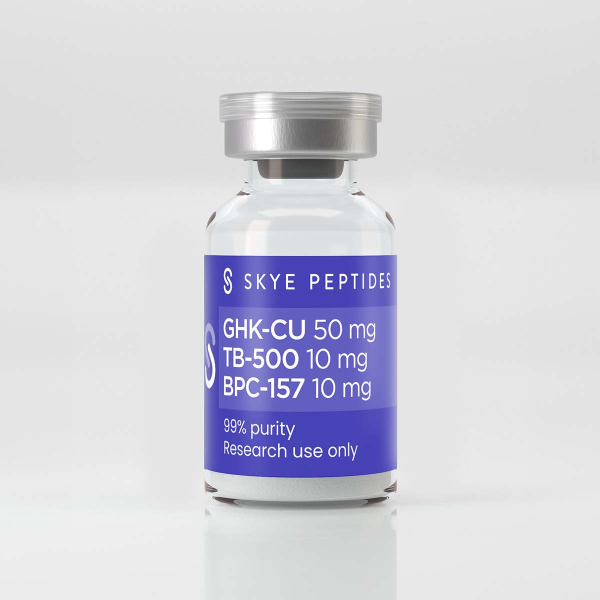
BPC-157 10mg + TB-500 10mg + GHK-Cu 50mg
$192.00
The BPC-157 10mg + TB-500 10mg + GHK-Cu 50mg Tri-Blend is a sophisticated multi-peptide formulation designed for comprehensive regenerative research. This blend combines two potent repair peptides with a high concentration of the copper-binding tripeptide GHK-Cu.
| Property | Specification |
|---|---|
| Compound A | BPC-157 (10mg) — C₆₂H₉₈N₁₆O₂₂ |
| Compound B | TB-500 / Thymosin Beta-4 (10mg) — C₂₁₂H₃₅₀N₅₆O₇₈S |
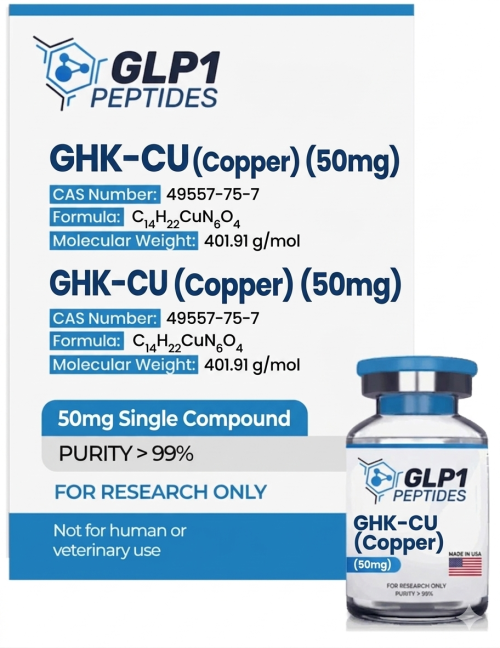
| Compound C | GHK-Cu (50mg) — C₁₄H₂₂CuN₆O₄ |
| Total Vial Content | 70mg lyophilized powder |
| Purity Rating | >99% (HPLC & MS verified, per constituent) |
| Format | Blue lyophilized powder (characteristic of the GHK-Cu copper complex) |
| Solubility | Reconstitutes in bacteriostatic or sterile water |
| Storage | Store at -20°C for long-term stability |
BPC-157 + TB-500 + GHK-Cu Tri-Blend for Sale | 99% Pure Regenerative Stack (70mg Total)
Most repair blends work one or two pathways. This one works three. The BPC-157 10mg + TB-500 10mg + GHK-Cu 50mg Tri-Blend puts systemic repair signaling, actin-driven cell migration, and extracellular-matrix remodeling in a single vial — and that third compound is the reason it stands apart. GHK-Cu, the copper-binding tripeptide, has been shown to modulate roughly 4,000 human genes — about 31% of the genome — according to a 2018 analysis by Pickart and Margolina (Regen Peptides research guide, 2026). That’s not a repair peptide; that’s a master regulator.
Stack it with BPC-157’s angiogenic cytoprotection and TB-500’s cytoskeletal remodeling, and you get a 70mg total research tool that lets a lab probe the interplay between repair, migration, and ECM remodeling without co-reconstituting three separate vials. You’ll also notice it looks different from every other peptide on your shelf — the characteristic blue powder comes straight from the copper complex.
At GLP1 Peptides, we supply this Tri-Blend verified to 99%+ purity on each constituent, backed by a batch-specific Certificate of Analysis (COA), and shipped to laboratories across the USA, Canada, Germany, and France. Here’s the full picture.
Research Use Only. This Tri-Blend is supplied strictly for in-vitro laboratory and analytical research by qualified professionals. It is not a drug, supplement, food, or cosmetic, has not been evaluated by the FDA, and is not intended for human or veterinary use.
What Is the BPC-157 + TB-500 + GHK-Cu Tri-Blend?
One lyophilized vial, three distinct compounds, each with its own well-mapped role in tissue homeostasis.
BPC-157 (10mg) is a stable 15-amino-acid gastric pentadecapeptide isolated in 1991, with 180+ peer-reviewed papers behind it (Loti Labs, 2026). TB-500 (10mg) is a synthetic form of the 43-amino-acid actin-sequestering protein Thymosin Beta-4. GHK-Cu (50mg) is glycyl-L-histidyl-L-lysine bound to copper — a tripeptide first discovered in human blood plasma in 1973, where its levels fall sharply with age
Three compounds, three pathways
This is where the tri-blend logic earns its name. Each compound enters tissue repair through a different door:
- BPC-157 upregulates VEGF and eNOS, driving angiogenesis and nitric-oxide-based cytoprotection.
- TB-500 binds G-actin to control the cytoskeletal reorganization that moves cells into damaged tissue.
- GHK-Cu stimulates fibroblasts to produce collagen, elastin, and glycosaminoglycans, while its copper acts as a cofactor for lysyl oxidase and lysyl hydroxylase — the enzymes that cross-link collagen so it doesn’t stay weak.
Notice the overlap point: all three influence VEGF and angiogenesis, but through separate biochemical channels. GHK-Cu even upregulates bFGF and VEGF in irradiated fibroblasts. So you’re not stacking redundant mechanisms, you’re triangulating the same outcome from three angles.
Why Researchers Buy the BPC/TB/GHK Tri-Blend
The multi-pathway format suits complex, multi-variable research. Here’s where it fits:
| Research Focus | What This Tri-Blend Is Used to Investigate |
|---|---|
| Multifaceted Tissue Regeneration | Combined effects of BPC-157 signaling, TB-500 actin sequestration, and GHK-Cu collagen modulation |
| Dermal & Soft-Tissue Repair | Upregulation of glycosaminoglycans and stimulation of fibroblasts |
| Complex Angiogenesis | How three compounds influence VEGF through distinct biochemical channels |
| Antioxidant & Anti-inflammatory Signaling | GHK-Cu free-radical quenching alongside BPC-157 cytoprotection |
| ECM Remodeling | Collagen, elastin, and decorin synthesis with MMP/TIMP modulation |
| Comparative Multi-Peptide Studies | Interplay of three regenerative pathways in one controlled model |
The GLP1 Peptides Quality Standard
A three-compound blend lives or dies on its ratio and its documentation. Here’s what backs every vial:
| Standard | What You Get |
|---|---|
| Verified 99%+ Purity | Each constituent confirmed by HPLC and Mass Spectrometry |
| Precision Ratio Formulation | A homogeneous 10mg / 10mg / 50mg distribution in every vial |
| Analytical Transparency | A batch-specific Certificate of Analysis (COA) ships with every order |
| Superior Lyophilization | Advanced freeze-drying protects the peptide sequences and copper-complex stability |
Technical Product Specifications
| Property | Specification |
|---|---|
| Compound A | BPC-157 (10mg) — C₆₂H₉₈N₁₆O₂₂ |
| Compound B | TB-500 / Thymosin Beta-4 (10mg) — C₂₁₂H₃₅₀N₅₆O₇₈S |
| Compound C | GHK-Cu (50mg) — C₁₄H₂₂CuN₆O₄ |
| Total Vial Content | 70mg lyophilized powder |
| Purity Rating | >99% (HPLC & MS verified, per constituent) |
| Format | Blue lyophilized powder (characteristic of the GHK-Cu copper complex) |
| Solubility | Reconstitutes in bacteriostatic or sterile water |
| Storage | Store at -20°C for long-term stability |
How to Reconstitute and Store the Tri-Blend (Laboratory Handling)
Seventy milligrams across three compounds — including a copper complex — makes careful handling non-negotiable. These are standard in-vitro lab steps, not use directions.
Reconstitution, step by step
| Step | Action |
|---|---|
| 1 | Check your COA and inspect the vial seal, cap, and the blue lyophilized cake |
| 2 | Let the sealed vial reach room temperature to avoid condensation |
| 3 | Add bacteriostatic or sterile water slowly down the inner glass wall — never onto the powder directly |
| 4 | Swirl gently until fully dissolved. Do not shake; agitation stresses all three constituents |
| 5 | Aliquot into single-use portions — three compounds and 70mg total make freeze-thaw discipline essential |
Storage at a glance
- Lyophilized powder: store at -20°C, sealed, away from heat, light, and moisture.
- Reconstituted solution: refrigerate at 2–8°C, protect from light, and avoid repeated freeze-thaw cycles.
- Copper note: GHK-Cu is a stable copper chelate, but shielding the solution from light and heat protects the complex over time.
- Inspect before every use: the solution should stay clear-to-blue; discard anything cloudy or discolored.
Cold, dark, dry, aliquoted — and with a copper peptide in the mix, light protection matters more than usual.
BPC-157 + TB-500 + GHK-Cu Tri-Blend vs Dual Blend vs Single Peptides
Buyers weigh these formats against each other constantly. Here’s what each one covers.
| Format | Pathways Covered | Emphasis | Best For |
|---|---|---|---|
| BPC-157 + TB-500 + GHK-Cu | Repair + migration + ECM remodeling | Full three-pathway coverage | Complex, multi-variable regeneration studies |
| BPC-157 + TB-500 (dual) | Repair + migration | Angiogenesis and cell motility | Tissue-repair synergy without ECM focus |
| GHK-Cu alone | ECM remodeling | Collagen, elastin, gene modulation | Dermal, cosmetic, and matrix-focused research |
| BPC-157 or TB-500 alone | Single pathway | Isolated mechanism | Clean single-variable control |
The takeaway: if your model needs the collagen and ECM layer on top of the repair-and-migration duo, the tri-blend gives you all three in one homogeneous vial — no juggling separate reconstitutions or mismatched ratios.
BPC-157 + TB-500 + GHK-Cu Tri-Blend for Sale — Availability and International Shipping
Ready to run a full multi-pathway study? Our research-grade Tri-Blend ships as HPLC/MS-verified, COA-backed lyophilized vials. We serve laboratories and independent researchers across the highest-demand markets:
- 🇺🇸 USA — fast domestic dispatch
- 🇨🇦 Canada — reliable cross-border delivery
- 🇩🇪 Germany (Deutschland) — trusted EU logistics
- 🇫🇷 France — secure European shipping
- Global delivery
Every order arrives sealed, documented, and bench-ready. When you buy the BPC-157 + TB-500 + GHK-Cu Tri-Blend from GLP1 Peptides, you’re paying for a verified three-compound ratio and full data integrity — the foundation any multi-pathway study is built on.
FAQs about the BPC-157 + TB-500 + GHK-Cu Tri-Blend
1. What is the BPC-157 + TB-500 + GHK-Cu Tri-Blend? It’s a single lyophilized vial containing 10mg BPC-157, 10mg TB-500, and 50mg GHK-Cu — 70mg total — supplied for comprehensive regenerative research across three pathways.
2. Why add GHK-Cu to a BPC-157 + TB-500 blend? GHK-Cu brings the extracellular-matrix layer: collagen, elastin, and glycosaminoglycan synthesis, plus antioxidant and gene-modulating activity. It complements BPC-157’s angiogenesis and TB-500’s cell migration rather than duplicating them.
3. What is GHK-Cu? GHK-Cu (glycyl-L-histidyl-L-lysine copper complex) is a naturally occurring copper-binding tripeptide discovered in human plasma in 1973. It stimulates fibroblasts and regulates ECM remodeling, and it’s one of the most-studied peptides in skin and wound research.
4. Why is the powder blue? The blue color comes from the copper in GHK-Cu. It’s a normal, expected characteristic of the copper-peptide complex — not a sign of contamination.
5. How do the three compounds work together? They triangulate tissue repair: BPC-157 builds vasculature and protects cells, TB-500 moves repair cells into place via actin dynamics, and GHK-Cu rebuilds the collagen matrix. All three touch VEGF, but through separate channels.
6. Is the BPC-157 + TB-500 + GHK-Cu Tri-Blend FDA approved? No. None of the three compounds is FDA-approved as an injectable drug. GHK-Cu is widely used topically in cosmetics, but this research blend is for laboratory use only and hasn’t been evaluated by the FDA.
7. Are these peptides banned in sport? BPC-157 and TB-500 are both WADA-prohibited under Section S0 (non-approved substances), with TB-500 banned since 2011. GHK-Cu is not specifically listed, but because the blend contains BPC-157 and TB-500, the vial as a whole includes prohibited substances. Tested athletes should note this.
8. How should the BPC-157 + TB-500 + GHK-Cu Tri-Blend be stored? Keep the lyophilized powder at -20°C, sealed and away from light. After reconstitution, refrigerate at 2–8°C, protect from light to guard the copper complex, and avoid freeze-thaw cycles.
9. How do you reconstitute a three-compound blend? The same way as a single peptide — room temperature, add bacteriostatic or sterile water down the glass wall, swirl gently, then aliquot. The BPC-157 + TB-500 + GHK-Cu Tri-Blend dissolve together. See the how-to table above.
10. What purity should the BPC-157 + TB-500 + GHK-Cu Tri-Blend be, and how do I verify it? Aim for 99%+ per constituent, confirmed by HPLC and Mass Spectrometry, with a lot-specific COA covering all three compounds. Ours ships with exactly that.
11. Can I isolate one compound’s effect from a tri-blend? Not cleanly — a fixed blend is designed for combined, multi-pathway study. To isolate a single mechanism, use single-compound vials for tighter variable control. The comparison table above shows when each format fits.
12. Where can I buy the BPC-157 + TB-500 + GHK-Cu Tri-Blend that ships internationally? GLP1 Peptides ships the research-grade, COA-verified Tri-Blend to the USA, Canada, Germany, and France, in sealed lyophilized vials. Availability details are above.
Verified. Documented. Research-ready. Every vial of the BPC-157 + TB-500 + GHK-Cu Tri-Blend from GLP1 Peptides is HPLC/MS-tested to 99%+ purity per constituent and shipped with a batch-specific COA, because a three-pathway study deserves a three-compound blend you can actually trust.
Reviews
There are no reviews yet.